
The Now Is a Feeling, Not a Time
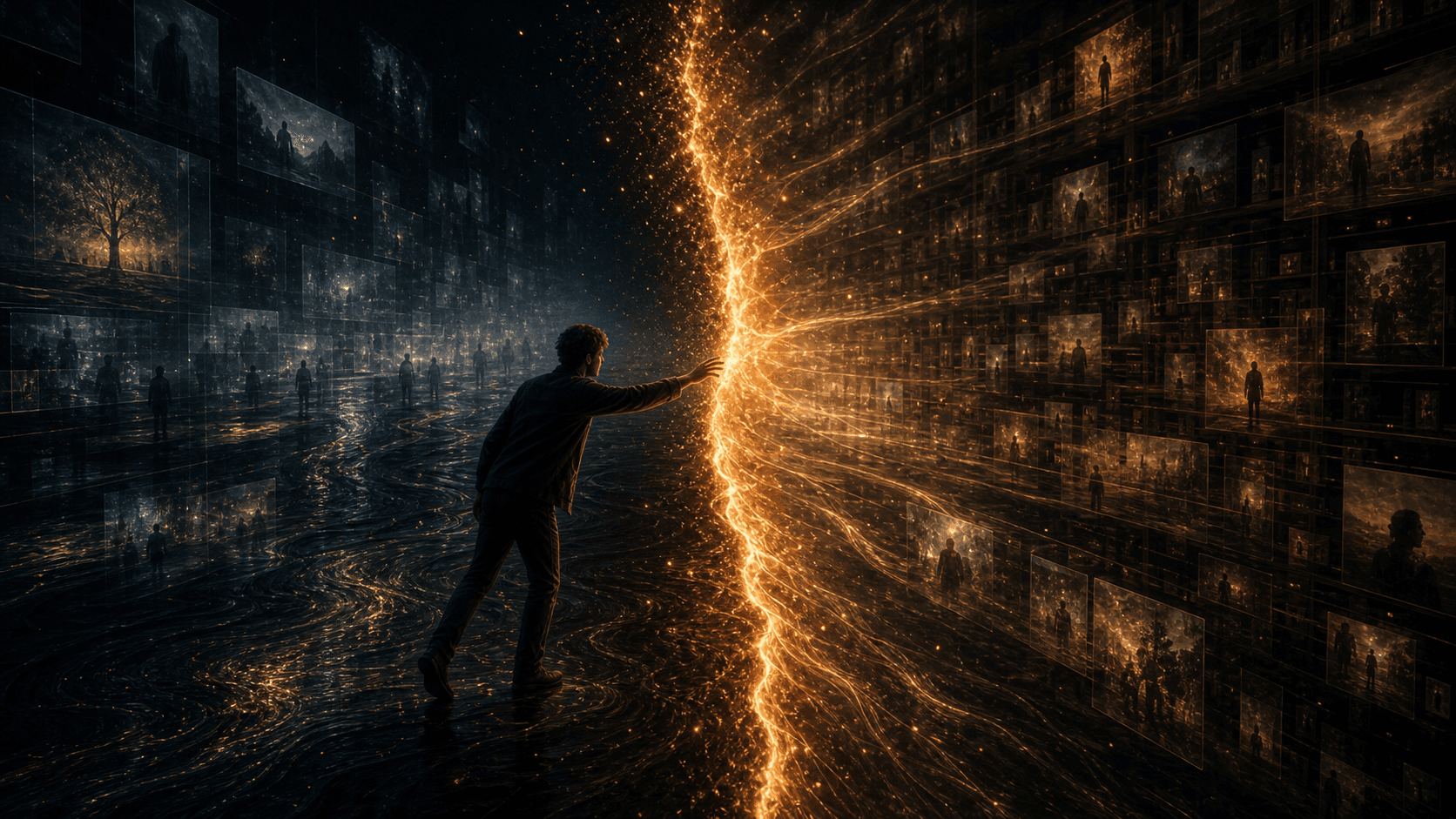
Try to catch the present moment and hold it. You cannot. The instant you notice something is happening, it has already happened. The noticing comes after the event, and by the time you have it, it is gone. The present is the one piece of time you can never actually occupy, because occupying it would require stopping it, and it does not stop.
This suggests the present is not really a time at all. It is a feeling. The sensation of immediacy that surrounds an experience in the brief moment before it gets filed away as memory.
The present is not a duration you can stand in. It is the felt edge where experience becomes memory. By the time you register that something is happening, it has already become something that just happened.
The present cannot be occupied
We talk about the present as though it were a place, a slice of time we live inside while the past recedes behind us and the future approaches ahead. But the slice has no thickness. Any moment you try to grasp as "now" is already behind you by the time you grasp it. The act of registering the present converts it into the recent past [1].
This is not a trick of language. It reflects how experience actually works. There is the event, and then there is the awareness of the event, and the awareness always lags. By the time "this is happening" forms in the mind, the raw event has already crossed into "this just happened." The present, as a thing you can stand in and inhabit, keeps dissolving at the exact moment you reach for it [1, 2].
So the present is not a duration. It is a threshold. The edge where the not-yet-experienced becomes experience and then immediately becomes memory. We cannot live in it because there is no in. There is only the crossing.
What "now" actually is
If the present cannot be occupied, then what is the thing we call "now"? It is a feeling. The sensation of immediacy, of vividness, of the world being fresh and live, that surrounds an experience in the instant before the mind files it [2].
This glow of immediacy is real as a feeling, but it is not a location in time. It is the quality experience has while it is being converted, before it has been named, compared, narrated, or stored. The "now" is what the conversion feels like from the inside. Not a moment we live in, but the felt texture of the world passing through us on its way to becoming record [2, 3].
This is why "now" feels so different from memory even though, on inspection, we can never actually catch it. The difference is not that one is present and one is past. The difference is that one carries the feeling of immediacy and the other does not. The present is defined by a sensation, not by a position on a timeline.
Living in a moving archive
If the present is only the felt edge of conversion, then where do we actually live? In the archive. In the accumulated record of everything that has already crossed from experience into memory [3].
A person is walking around inside layers of stored afterimages: childhood rooms, old conversations, faces, songs, things they wish they had said, moments replayed so many times they have become myth. This archive is not a backdrop to a life lived in the present. It is where the life is actually conducted. The present is just the newest layer entering the archive, the most recent deposit, already past by the time it is registered [3].
We imagine ourselves as beings who live in the present and occasionally consult the past. The reverse is closer to true. We live in the past, in the stored record, and the present is only the thin entering edge of new material. What we call experiencing the world is mostly the activity of an archive taking in its next entry, which is filed almost as fast as it arrives [4].
Memory degrades what it holds
There is a further turn. The archive does not preserve its entries faithfully. Memory is not a stored object that stays fixed. It is reconstructed each time it is accessed, and each reconstruction can alter it. The original moment happens once. After that, the mind makes copies, and copies of copies, each one slightly changed [4].
So the entry that enters the archive at the felt edge of the present immediately begins to degrade and shift. The first experience becomes a memory. The memory becomes a story. The story becomes part of an identity. And that identity then shapes how future moments at the felt edge are experienced in the first place. The archive is not just storage. It is a lens that bends the incoming present even as it files it [4].
This means a life is not a sequence of moments we possessed. It is a sequence of disappearances we later consult, in increasingly edited form. The moments were only fully alive at the felt edge, before we could hold them, and what we keep is the residue, reworked every time we return to it.
The point
The present moment is not a time you can occupy. It is the feeling of immediacy that surrounds experience in the instant before it becomes memory. By the time the mind registers that something is happening, it has already become something that just happened. The present is a threshold, not a duration, and it dissolves the moment you reach for it.
This means we do not live in the present the way we imagine. We live in a moving archive of everything that has already crossed over, and the present is only the newest layer entering it, already past as it arrives. And the archive does not hold its contents still: every memory degrades and shifts with each access, so what we keep is edited residue, not preserved fact.
A life is not a collection of moments we held. It is a series of disappearances we consult afterward. The world was only fully alive at the felt edge, the burning point where the unexperienced becomes experience and then immediately becomes memory. That edge is the only present there is, and it cannot be stood in. It can only be crossed.
Sources
- Husserl, E. (1928). On the Phenomenology of the Consciousness of Internal Time. On the structure of time-consciousness: the present is not a point but a flow in which each now immediately becomes a just-past, retained in consciousness rather than occupied as a standing moment.
- James, W. (1890). The Principles of Psychology. Henry Holt. On the "specious present": the experienced present is not an instant but a felt span with duration, a sensation of immediacy rather than a precise point in time.
- Dainton, B. (2000). Stream of Consciousness: Unity and Continuity in Conscious Experience. Routledge. On how conscious experience is structured as a continuous flow in which the present is constituted by the ongoing transition of experience into retained content.
- Schacter, D. L. (1996). Searching for Memory: The Brain, the Mind, and the Past. Basic Books. On reconstructive memory: each act of recall rebuilds and potentially alters the memory, so that stored experience degrades and shifts over time rather than remaining a fixed record.