
The Child King
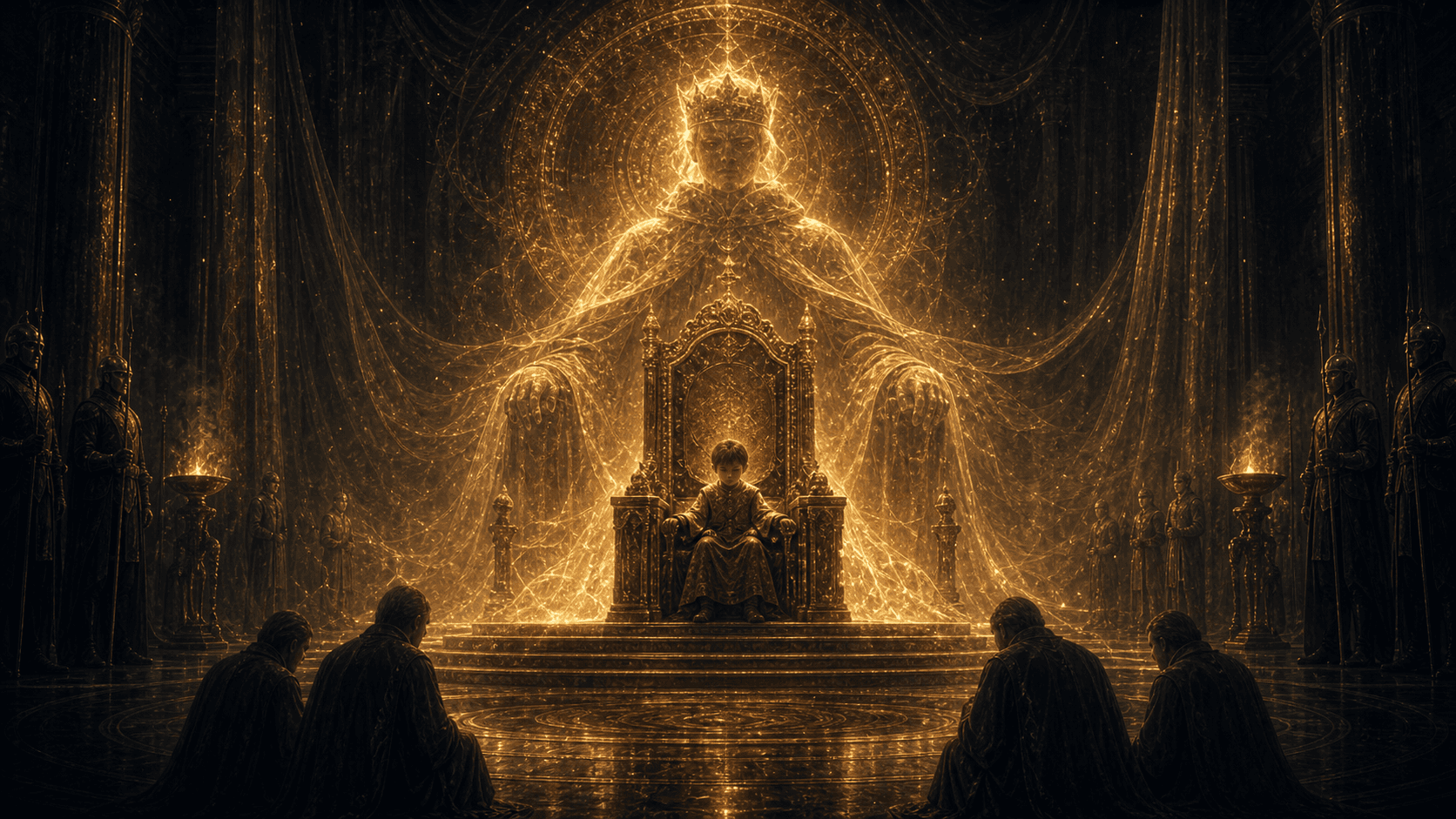
Imagine a king who is eight years old. The court bows. The robes, the throne, the guards, the inheritance, the ritual all announce: this person is above you, this person rules, this person knows. And yet underneath the costume is a child. The crown did not make him wise. It made everyone treat him as wise. The wisdom was projected onto the position, not produced by the person.
The child king is an extreme case of something ordinary. Position generates an authority aura, and the aura is constantly mistaken for inner capacity. The throne keeps promising a depth that the person on it may not have.
Position creates an authority aura that does not necessarily match inner capacity. A person can be fully developed in one domain and a child in another. The costume of status keeps promising capacities that may not appear.
The aura is produced by the position
When someone occupies a position of standing, the environment around them does the work of signaling competence. Age signals wisdom. Wealth signals capability. A title signals authority. Marriage and parenthood signal maturity. The signals are structural: they come from the role, not from any inspection of the person inside it [1].
This is efficient. Societies cannot test everyone's inner capacity directly, so they use position as a proxy. The proxy usually works well enough to function. But it has a failure mode: the proxy can be fully present while the capacity it is supposed to indicate is absent. The throne is real. The robes are real. The standing is real. And the inner sovereign may still be a child [1, 2].
The aura is not a lie anyone is telling. It is an automatic projection produced by the position itself. We see the markers and the mind fills in the depth. The filling-in happens before any evidence about the actual person arrives, which is exactly why the child king is treated as wise. The court is responding to the crown, not to the boy [2].
Developed in lanes
The deeper point is that human development is not a single quantity. A person is not simply mature or immature, developed or undeveloped. They are developed in specific lanes, and the lanes are surprisingly independent of one another.
Someone can be highly developed in financial competence and barely developed in emotional repair. Highly developed in professional skill and undeveloped in humility. Developed in the logistics of parenthood and undeveloped in the emotional capacities parenthood is assumed to confer. Developed in argument and undeveloped in the ability to witness another person. The lanes do not rise together. Growth in one does not transfer to the others [3].
This is what the authority aura obscures. The markers of status indicate development in their own lane and are read as development across all lanes. Wealth indicates competence with money and gets read as competence with people. Age indicates accumulated time and gets read as accumulated wisdom. The proxy is valid for one lane and invalid for the others, but the aura does not distinguish. It promises whole-person depth on the basis of single-lane achievement [3].
So a person can be structurally adult, holding all the markers of arrival, and remain undeveloped in the specific lane that a given situation actually requires. The markers are accurate about what they directly measure and misleading about everything else.
Why the gap is hard to see
The gap between position and capacity is unusually hard to perceive, for two reasons.
First, the aura works on the observer automatically. We do not decide to credit the king with wisdom; the crown does it for us before we have weighed anything. To see the actual capacity, we have to override an automatic projection, and overriding it feels almost transgressive, like refusing to honor something that is plainly being honored by everyone around us [2].
Second, the markers protect the person inside them from having to develop the missing lanes. If status already produces the appearance of capacity, there is little pressure to build the capacity itself. The aura does the work that growth would otherwise be required to do. So the higher the status, the less the underdevelopment is challenged, and the more invisible it becomes, including to the person carrying it. Status makes its own gaps harder to see and harder to admit [1, 3].
This is why pointing at the gap is destabilizing. It is not only a claim about a person. It is a refusal of the symbolic order that everyone, including the person, has been relying on. The markers said depth. To say the depth is not there is to say the costume was covering an absence.
When the demand exposes the lane
The gap usually stays hidden until a situation demands the specific undeveloped lane. As long as the situation only requires the lane the person is developed in, the aura and the capacity appear to match. The wealthy person handles money well. The professional handles the work well. Nothing exposes the gap [3].
But when a situation demands a different lane, emotional truth, repair, humility, the capacity to witness, the markers suddenly fail to deliver what they seemed to promise. The person who looked fully adult cannot do the adult thing the moment requires. The aura said they could. The lane was never built. The demand is what reveals the difference between structural adulthood and adulthood in the specific dimension now being asked for [2, 3].
This is the moment the child king is exposed: not in the throne room during ceremony, where the position is all that is needed, but in the situation that requires the actual capacity the position was assumed to contain.
The point
Position creates an authority aura, and the aura is routinely mistaken for inner capacity. A child on a throne is treated as wise because the throne signals wisdom; the crown produces projection, not depth. This is an ordinary mechanism, not a rare one, because societies use position as a proxy for capacity, and the proxy can be fully present while the capacity is absent.
The reason the proxy misleads is that development happens in independent lanes. A person can be highly developed in one domain and a child in another, and the markers of status indicate one lane while being read as whole-person depth. Wealth, age, title, and role are accurate about what they directly measure and misleading about everything else.
The gap is hard to see because the aura works automatically on observers and because status shields the person from having to build the missing lanes. So the underdevelopment stays invisible, often to the person most of all, until a situation demands the specific lane that was never built. Then the difference between holding a position and having the capacity the position implies becomes suddenly, undeniably clear. The throne was always real. The question is who is actually sitting on it.
Sources
- Weber, M. (1922). Economy and Society. University of California Press. On the distinction between the authority conferred by position and office and the personal qualities of the individual holding it, and how legitimacy attaches to the role rather than the person.
- Cialdini, R. B. (1984). Influence: The Psychology of Persuasion. Harper Business. On the authority principle: how symbols of status and position automatically trigger deference and assumptions of competence, independent of the actual qualities of the person displaying them.
- Kegan, R. (1982). The Evolving Self: Problem and Process in Human Development. Harvard University Press. On developmental stages as domain-relevant rather than global, and how a person's level of development in one area of functioning need not correspond to their development in others.