
The Machinery of Familiar
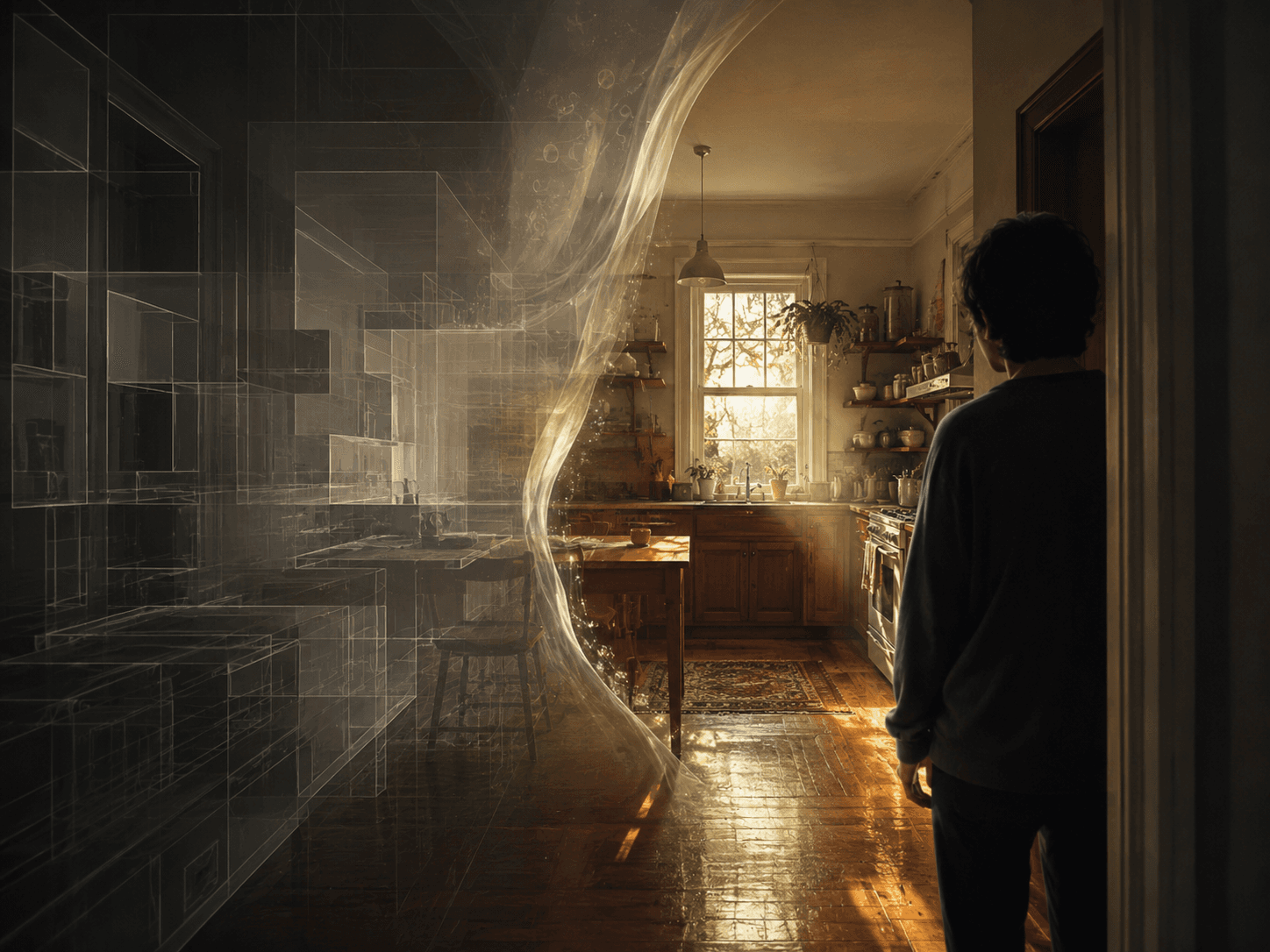
You have had the experience of coming back from a long trip. You walk into your own house and for a moment, just a moment, something is wrong. Not wrong in a bad sense. Wrong in the sense that you are actually seeing it. The shape of the kitchen, the particular height of the ceiling, the way the light falls in from that window: all of it is briefly vivid, briefly specific, briefly there in a way it was not there the day before you left. Then it closes over again and it is just your kitchen, which is not really a thing you see anymore.
What happened in that moment is the most accurate perception you have had of your own house in years.
The strangeness of the world is not gone. It has been filed.
The gap between what your senses are receiving and what your mind is showing you is wider than most people realize. What you experience as perception is mostly not perception. It is a rendering. Your brain takes the incoming signal, compares it to an existing model, and, if the model is a close enough match, shows you the model instead of the signal. The signal keeps arriving. You are just not being shown it.
What the brain is actually doing
The predictive-processing account of perception is one of the better-supported frameworks in contemporary neuroscience [2, 3]. The rough version is this: the brain is not a passive receiver. It is an active predictor. At every level, from the retina to the cortex, the system is running predictions about what the incoming signal will be. When the prediction matches the signal, there is nothing to report upward. When there is a mismatch, that mismatch, the prediction error, is what gets sent to higher processing for attention.
The consequence is that most of what you experience as perception is actually your own prediction system, and the world breaks in only at the edges: at the places where the prediction was wrong, where the signal was unexpected, where something did not match the model [4, 5]. Your experience of your daily environment is almost entirely constructed from your model of that environment. The model was built from earlier attention. But the attention that built it is now gone, and the model is what remains.
Familiarity is a word for prediction confidence. A familiar thing is a thing your model is so sure of that it stopped submitting the raw signal for inspection. The signal is still arriving. Your eyes are still capturing it. Your ears are still receiving it. The machinery just does not forward it anymore, because it already knows what it will say.
What you are no longer seeing
The room you wake up in every morning. You do not see it. You have not seen it, in any full sense, since the first weeks of living there. You see a model of it, a very good model, updated for major changes, blind to the ordinary ones. The particular quality of the light at this time of day. The texture of the wall at this angle. The exact distance from the bed to the door. These are no longer arriving as experience. They are running as background prediction, confirmed automatically, filed without delivery.
Your own face in the mirror is one of the stranger cases. You see it every day. Most people cannot describe it accurately from memory, because they have never actually looked at it. They have looked at their prediction of it, which is close enough to match and therefore close enough to skip. The actual face, with its specific asymmetries and proportions, is not a thing most people have full sensory access to [3].
The voice of someone you have lived with for ten years. The feeling of your own hands. The smell of your own home. The route you walk to the place you go most often. All of these were, at some point, vivid. All of them have been eaten by the model. The model is more efficient than the raw signal. The model is also a past version of reality, continuously updated for dramatic changes, not for the ordinary slow drift of the thing itself.
The cost of efficiency
This is adaptation, and adaptation is not a failure. The brain solves the cost-of-processing problem the only sensible way: by investing attention where it matters, where predictions are failing, where something needs to be updated. If everything were as vivid as a new experience, you could not function. The signal load would be overwhelming. The filing system exists for good reasons [6].
But the cost is real. You stop living inside your actual life and start living inside your model of your life. Your model is stable, efficient, and behind. It represents the world as it was when you last paid full attention, and it is continuously lagging the present by the amount of time since you last looked properly. For things that change slowly, or not at all, the lag is invisible. For things that change in the ordinary ways of living things, the lag is where the most important information gets lost.
Relationships go stale not because the people in them stop changing but because the models of those people stop updating. You stop seeing the person in front of you and start seeing the version your prediction system is confident in. That version is past. The person has been saying something different for a while, and you have been hearing the predicted version of what they say.
What artists figured out
Artists, from at least the early twentieth century, have known this problem explicitly [1]. The Russian formalists named it: the word they used was ostranenie, usually translated as defamiliarization or making strange. The job of art, in this account, is to interrupt the prediction. To show you something that has been filed in a way that defeats the filing. To force the raw signal through.
Tolstoy narrating a flogging through the eyes of a horse who does not have the cultural frame to predict what a flogging is. Kafka describing the Prague bureaucracy with literal exactness, which is stranger than any metaphor because the literal thing has been made unfindable by familiarity. A photographer choosing an angle your prediction system was not built for, making visible what has been in your visual field for years without arriving.
None of these techniques create something that was not there. They remove the layer that was preventing it from arriving. The strangeness was always there. The technique is only about defeating the mechanism that was filtering it out.
The dissolution experiences that people describe in certain states, high fever, extreme grief, the first few moments after anesthesia wears off, sometimes induced by certain substances: these are largely what happens when the prediction machine loses confidence. The world comes back, but it comes back raw, without the labeling, and the experience is overwhelming in both directions. Too much. Too vivid. Too present. That is just what the world is like when the filing system fails. The model is so good that its absence is not liberation. It is vertigo.
How to interrupt the machinery without leaving
You cannot turn the prediction system off. It runs below your control and it is doing something essential. What you can do is confuse it.
The prediction model is built at a particular scale and from a particular viewpoint. Switching scale bypasses it. Look at a familiar surface at a resolution your model was not built for. The grain of wood. The weave of a fabric you have touched a thousand times. At that scale, the prediction does not have a prepared answer. The raw signal arrives for a moment before the model catches up.
Change the viewpoint physically, not conceptually. Lie on the floor of your own room and look up at the ceiling. Look at a face from an angle you never use. The model was calibrated from your usual position. Move position and the model loses confidence.
Most straightforwardly: stop naming things for a moment. Pick an object and try to look at it without attaching the label. Not for long. For the seconds before the label arrives. That window, narrow as it is, is what the object actually is. The label is a summary. The thing precedes the summary. In that narrow window, before the machinery catches up, the thing itself is available.
The point
The world has not become less extraordinary since you were young. The extraordinary has been filed. The filing system is doing its job. Nothing has gone wrong. This is just what happens when a finite-attention system lives inside a continuous environment long enough.
The interesting question is not how to live without the prediction system. You cannot. The interesting question is whether you can stay near the edge of it: near the place where the predictions are still forming, where the model does not yet have a confident answer, where the raw signal is still getting through. That edge moves. It is wherever the new thing is, wherever you just arrived, wherever you changed the angle.
Most of what is interesting about being alive is in that narrow band. It has not gone anywhere. It is just behind the model you built to protect yourself from having to look at everything from scratch every time. The model is useful. It is also not the world.
Sources
- Shklovsky, V. (1917). "Art as Technique." In Russian Formalist Criticism: Four Essays, ed. L. T. Lemon & M. J. Reis, University of Nebraska Press. The original formulation of defamiliarization: habitualization devours objects, clothes, furniture, one's wife, and the fear of war. Art exists to restore the sensation of life, to make the stone stony, by making the familiar strange again.
- Clark, A. (2016). Surfing Uncertainty: Prediction, Action, and the Embodied Mind. Oxford University Press. The predictive processing account: the brain as a hypothesis-testing machine that only forwards prediction errors upward, not confirmations, so what we experience as perception is mostly the current best prediction.
- Seth, A. (2021). Being You: A New Science of Consciousness. Faber. Perception as controlled hallucination; the brain's predictions are the primary experience, and the external world is inferred rather than received directly.
- Friston, K. (2010). "The free-energy principle: a unified brain theory?" Nature Reviews Neuroscience, 11(2): 127-138. The mathematical formulation of predictive processing: the brain minimizes surprise by revising predictions, and prediction error rather than raw signal is what drives learning and awareness.
- Hohwy, J. (2013). The Predictive Mind. Oxford University Press. On inference to the best explanation as the basic structure of perception, and what happens when prediction confidence becomes so high that the signal itself is suppressed.
- Langer, E. J. (1989). Mindlessness. Addison-Wesley. On premature cognitive commitment: how early categorization leads to inattention to the actual present state of things, with the category substituting for ongoing observation of the object.