
The Continuum Observer
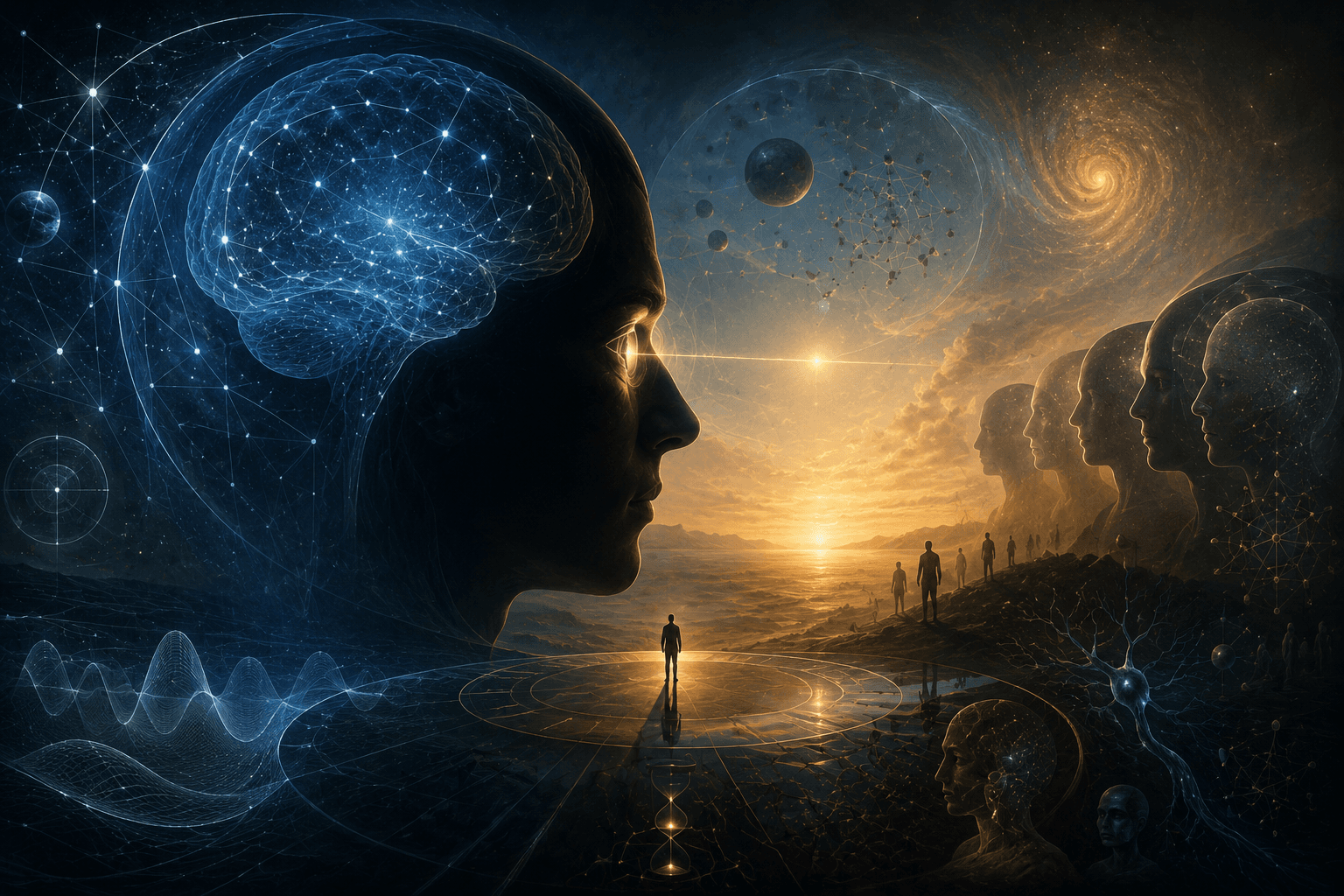
On awareness, identity, and why you can never step outside your own observation.
Awareness is not located inside you. It is the field through which experience arises. Your brain is the structure that gives awareness identity, continuity, and narrative. Without a functioning brain, awareness has no content. No self. No memory. No story.
Objective reality is pattern unfolding. It does not require an observer. You do not create reality by observing it. You generate an experience of it.
This is the core claim of the theory, and the rest of what follows is an unpacking of what it means to live inside that claim, rather than beside it.
I. Awareness is the field, the brain is the instrument
The usual picture places awareness inside the skull, as if consciousness were a small observer sitting behind the eyes, receiving the world through the senses. That picture does not survive inspection. The neural correlates of consciousness studies over the past three decades have repeatedly shown that what we call awareness is not generated by a single region or a single process, but emerges from large-scale integration across cortical networks [1, 2]. No one has ever found the "seat" of the observer, because there is no seat. There is only the pattern of integration, and the integration is not a thing in a place. It is a process running in a structure.
This is why the brain is better understood as an instrument than as the source. The brain does not produce awareness the way a battery produces current. It shapes awareness the way a lens shapes light: it gives the field a particular form, a particular bandwidth, a particular set of discriminations, and that form is what we experience as being a someone. Change the instrument and the form changes with it. Damage it precisely and specific features of the self drop out while awareness itself remains, often strangely intact [3].
II. Without a functioning brain, awareness has no content
This is the hardest claim to sit with, and it is also the most load-bearing. If the brain is the instrument, then when the instrument stops working, what is left is not a disembodied self floating free. What is left is a field with no content. No memories. No narrative. No sense of being anyone in particular.
Anesthesia provides the cleanest demonstration available [4]. Under general anesthesia, the brain's global integration is disrupted and the experience of being a self ceases entirely. It does not get darker. It does not get quieter. It stops. People who undergo anesthesia do not experience the passage of time during it. They experience nothing. The instrument was turned off, and the field, without an instrument to shape it into an identity, produced no experiencer.
Deep sleep gives a softer version of the same evidence. In dreamless sleep, phenomenal content dissolves, and with it the sense of being a continuous self [5]. Every morning is a reconstruction. The you who wakes up is not the you who fell asleep. The continuity you feel is itself a narrative the brain assembles, not a thing that survived the night.
III. Objective reality is pattern unfolding, with or without you
If awareness is a field that gets shaped into experience by a brain, then what is the world doing while the brain is not looking. The theory's answer: the world is what it has always been doing, which is running. Patterns are unfolding. States are becoming other states. Causal relations are being honored. The physical universe does not pause when no instrument is tuned to it.
This is not a metaphysical claim that requires accepting quantum idealism. It is the baseline assumption that any coherent physics rests on: the world has dynamics that are indifferent to being observed [6]. What the observer contributes is not the pattern. It is the experience of the pattern. Subtract every consciousness in the universe and what remains is not nothing. What remains is the pattern without anyone for whom it is anything.
The inversion this forces is important. You do not generate reality. You generate an experience of reality. The experience is real. It is produced, continuously, by your brain shaping the field of awareness into a structured phenomenal world. But it is not the world. It is your instrument's output. Mistaking the output for the world is the oldest confusion in philosophy, and the one this theory is most concerned with undoing.
IV. Time is internal
Time, in this framework, is not an external stage your life occurs on. It is the way awareness sequences change. The felt sense of past flowing into future is a product of memory running forward alongside prediction, with the brain comparing what was to what is to what is likely to be [7]. Remove the comparison and the flow stops. The present, without memory, has no duration. It just is.
Physics has been quietly consistent with this for a century. The fundamental equations of physics are time-symmetric. There is no arrow of time built into the mathematics. The arrow emerges from thermodynamics and from the particular way observers, as embedded subsystems, accumulate information about their environments [8]. Time, as we feel it, is an internal product. It is not the medium the universe swims in. It is the wake that instruments like us leave behind.
There is no external timeline your life sits on. There is only the pattern, unfolding, and your brain's continuous act of turning that unfolding into the felt experience of before, now, and after.
V. Identity is constructed, not fundamental
Identity is the most convincing piece of fiction the brain produces. It feels solid, continuous, singular. It feels like the one thing you can be sure of. But it is assembled, moment by moment, from memory, narrative, body schema, social reflection, and a constant low-level background sense of ownership over this particular stream of experience [9].
The assembly is so fast and so seamless that we never see the seams. But the evidence that it is assembled is everywhere. Identity fragments under psychedelic drugs, dissolves in meditation, breaks down in certain neurological conditions, and vanishes entirely under anesthesia [4, 10]. If it were fundamental, none of that would be possible. You would survive everything as yourself, because yourself would be the ground. You do not. The ground is something else. The self is a process the ground runs.
What returns each morning is a reconstruction. It uses memory, continuity of body, and the brain's default mode network to rebuild the felt sense of "the person I am" before you are even fully awake. The fact that the reconstruction is reliable does not make it fundamental. It makes it a well-trained habit of a particular instrument.
VI. The observer is always part of what it observes
You cannot step fully outside your own perceptual apparatus. Every attempt to do so is itself performed by the apparatus. The observer, in trying to examine the observer, ends up generating more observation, not less. There is no view from nowhere available to a conscious being, because having a view at all requires being a somewhere.
Physics hit this wall formally in the early twentieth century. Heisenberg and Bohr found, in the mathematics of quantum mechanics, that the observer cannot be cleanly separated from the observed system [6]. Philosophy has been circling the same point since at least Kant: the conditions of experience structure experience, and those conditions are not optional. You cannot see the world without the apparatus that sees.
What this means practically is that total objectivity is not a goal that can be approached asymptotically. It is not a direction. It is a contradiction. The most honest move available is not to try to leave the apparatus. It is to include the apparatus in the description. Note that you are the observer. Note how the observer shapes what is observed. Then keep going, knowing that the observer you just noted was itself being observed by something that you also cannot step outside of.
VII. Awareness can observe itself observing
And yet, one move remains available, and it is the strangest and most interesting move a conscious being can make. Awareness can observe itself observing. The recursion is real. You can notice that you are noticing. You can become aware of the awareness. You can watch the watcher, and then watch the one watching the watcher, and so on.
This is not a philosophical trick. It is a measurable feature of human metacognition [11]. The brain has the capacity to model its own modeling. The observer can take itself as an object, even though taking itself as an object still happens inside the observer. The recursion does not resolve. It deepens. Each layer is another layer of the same field, folded back on itself.
This is the deepest move available to a conscious being. Not because it escapes the apparatus. It does not. But because it lets the apparatus include itself in what it is describing, and that inclusion is what we mean when we use the word awake. The recursion is not a riddle to be solved. It is a direction to be traveled in. There is no last layer. There is only more awareness, meeting itself, as it has been doing quietly inside every conscious moment you have ever had.
The point
You are not inside your awareness. You are the shape awareness takes when it runs on a brain. The brain is the instrument, not the source. The field is there whether or not any instrument is tuning into it. The world is there whether or not the field has been tuned. What you call yourself is the specific, temporary, beautifully constructed pattern that happens when a particular brain shapes a particular region of the field into a particular experience of being someone. That pattern is real. It is also not where you end. Where you end, if the theory is right, is much stranger and much larger than the person you take yourself to be.
Sources
- Tononi, G., Boly, M., Massimini, M., & Koch, C. (2016). "Integrated information theory: from consciousness to its physical substrate." Nature Reviews Neuroscience 17(7): 450-461. On large-scale integration as the substrate of conscious experience.
- Dehaene, S. (2014). Consciousness and the Brain. Viking. Synthesis of the global neuronal workspace theory and the evidence that awareness emerges from distributed cortical integration.
- Damasio, A. (2010). Self Comes to Mind: Constructing the Conscious Brain. Pantheon. On how specific brain regions contribute to the felt sense of self and what happens when they are damaged.
- Alkire, M. T., Hudetz, A. G., & Tononi, G. (2008). "Consciousness and anesthesia." Science 322(5903): 876-880. On the disruption of global integration as the mechanism of anesthetic unconsciousness.
- Siclari, F. et al. (2017). "The neural correlates of dreaming." Nature Neuroscience 20(6): 872-878. On the correspondence between phenomenal content and specific brain activity during sleep.
- Heisenberg, W. (1958). Physics and Philosophy: The Revolution in Modern Science. Harper. On the observer as part of the measured system in quantum mechanics.
- Wittmann, M. (2016). Felt Time: The Psychology of How We Perceive Time. MIT Press. On time perception as an emergent product of memory, prediction, and bodily processes.
- Rovelli, C. (2018). The Order of Time. Riverhead. On why time as we feel it is not a feature of the fundamental equations of physics.
- Metzinger, T. (2003). Being No One: The Self-Model Theory of Subjectivity. MIT Press. On identity as a continuously constructed phenomenal self-model, not a fundamental entity.
- Carhart-Harris, R. L. et al. (2014). "The entropic brain: a theory of conscious states informed by neuroimaging research with psychedelic drugs." Frontiers in Human Neuroscience 8: 20. On how identity and the default mode network can be disrupted, showing the constructed nature of self.
- Fleming, S. M. & Lau, H. C. (2014). "How to measure metacognition." Frontiers in Human Neuroscience 8: 443. On the empirical study of awareness observing itself.