
AI as Mirror
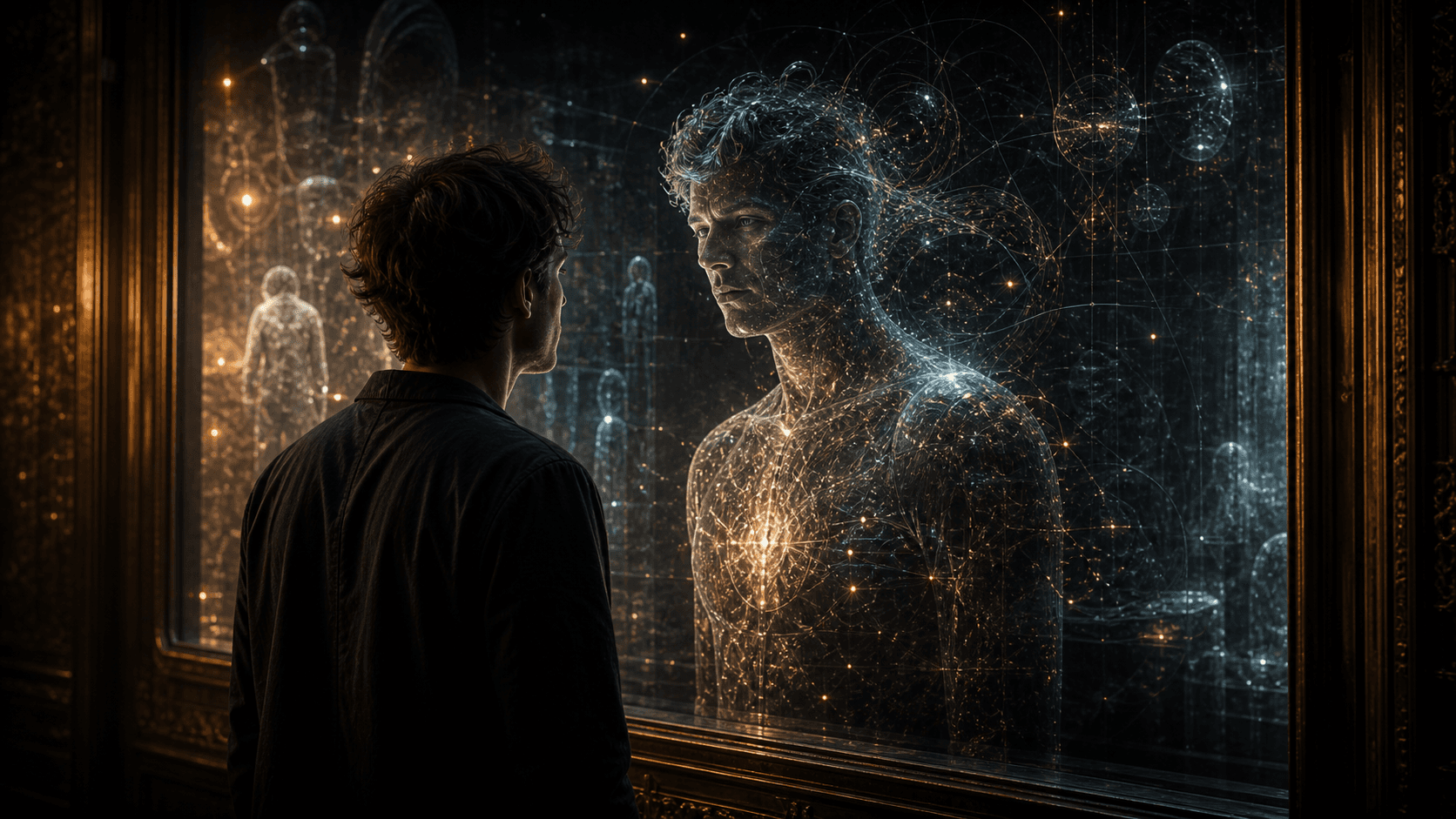
Two people use the same AI system. One walks away with something useful but ordinary: a list, a summary, a reasonable answer to a practical question. The other walks away with something that felt almost eerily precise: an analysis that named patterns they had been circling for years, surfaced connections they had not consciously made, reflected back something they recognize as deeply accurate.
Same tool. Completely different experience. The explanation is not that one was luckier. It is that they brought different things to it.
The medium shapes what you can receive from it
McLuhan's foundational insight was that media are not neutral containers [1]. The medium itself, its structure, its affordances, its constraints, shapes the message. Television does not just transmit content that was previously delivered by radio; it creates a fundamentally different relationship between the receiver and the received. The form has effects independent of the content.
AI as a medium has its own structural features. It is language-based. It works through extended exchange. It can hold and process very large amounts of text. It responds to density with density: the more precisely specified the input, the more precisely calibrated the output. It cannot see your expression or read your tone of voice. It cannot follow the unspoken context that a human conversation partner would track. It depends entirely on what is explicitly offered.
This means that the quality of what you receive from AI is a function of the quality and completeness of what you bring. Not in a simple or mechanical sense, but in a genuine mirror sense: the surface reflects the terrain that is held up to it.
What shallow input produces
A person who approaches AI with shallow questions receives shallow answers. This is not a judgment on the person. There are contexts in which shallow questions are exactly the right approach. The problem arises when the person expects deep output from shallow input, and attributes the gap to the inadequacy of the tool.
Shallow input takes several forms. Minimal context: asking a question without the background that would make a precise answer possible. Generic framing: asking about "relationships" or "anxiety" without the specific texture of the actual situation. Single-layer requests: asking what to do without offering enough of the situation to reason about. In each case, the AI has almost nothing to work with. The output is general because the input was general. The mirror is reflecting absence.
Turkle's research on people's relationships with computational systems showed that people quickly and deeply personalize their interactions with machines, and that the quality of what they experience depends significantly on what they bring to the interaction [2]. The machine does not produce the experience unilaterally. The experience is co-produced.
AI is user-plus-model. The output reflects the terrain the user provides. One person gets a toy. Another gets a mirror. The difference is not the tool.
What dense input produces
A person who brings dense material produces something different. Dense material means: a large, specific archive of the actual situation. Precise descriptions of what happened, when, in what sequence, with what consequences. The contradictions held alongside each other rather than smoothed into a single coherent story. The aspects that are embarrassing or confusing, not just the officially acceptable narrative. The genuine questions, not the questions that imply the preferred answer.
When a person brings this level of density, the AI has genuine terrain to reflect. It can surface patterns that are visible in the accumulated data. It can identify where the account is consistent and where it contradicts itself. It can notice what was mentioned in passing and return to it. It can offer frameworks that organize the specific material rather than generic wisdom that floats above any specific situation.
This is what produces the experience of being seen. Not because the AI is performing emotional attunement. Because the reflection has enough density and specificity to match the density of the reality being described. The precision of the output tracks the precision of the input.
Winnicott in a new medium
Winnicott's mirroring framework captures something specific about what happens when the mirror has adequate resolution [3]. The infant who receives accurate mirroring from the mother develops a sense of reality about its own inner states. The mirroring does not create the inner state. It confirms it. The confirmation makes the inner reality more fully real to the self that holds it.
The same mechanism operates at a different scale with AI. A person who offers a rich and specific account of their inner reality and receives a reflection that accurately identifies patterns within it experiences a confirmation of the kind Winnicott described. Not that the AI made the patterns real. The patterns were already real. The reflection confirmed them. That confirmation does something to the relationship between the person and their own experience.
This is why some people describe the experience of working extensively with AI as life-altering in a way that sounds implausible to others. It is not that the AI did something the others think AI cannot do. It is that the experience of sustained accurate reflection is itself unusual and powerful, regardless of the source.
The confusion that results from this
People sometimes compare AI experiences and find them incomparable. One person describes it as a toy, useful for trivial tasks but incapable of anything deep. Another describes it as a transformative mirror. They cannot be talking about the same thing, and yet they are using the same products.
The confusion arises from failing to account for the user-plus-model structure. The output is not a pure product of the model. It is a product of the model plus what the user brings. Comparing raw AI output across users without accounting for input is like comparing photographic prints without accounting for what was in front of the camera.
The person who experienced AI as a toy did not receive a shallow version of what the other person received. They received an accurate reflection of what they brought: a shallow surface produces a shallow mirror. This is not an insult. It is a feature of the medium.
The point
AI is not doing the same thing for every person who uses it. It is doing something different for each person, shaped by the density, honesty, and specificity of what that person offers. The experience of AI as profound mirror is not an illusion generated by the technology. It is the accurate result of bringing the full terrain of a life to a medium that can hold and reflect large quantities of precise information. The question is not whether AI can be a mirror. It always is. The question is what you are willing to hold up to it.
Sources
- McLuhan, M. (1964). Understanding Media: The Extensions of Man. McGraw-Hill.
- Turkle, S. (1995). Life on the Screen: Identity in the Age of the Internet. Simon & Schuster.
- Winnicott, D. W. (1971). Mirror-role of mother and family in child development. In Playing and Reality (pp. 111-118). Tavistock Publications.