
You Are Always in the Past
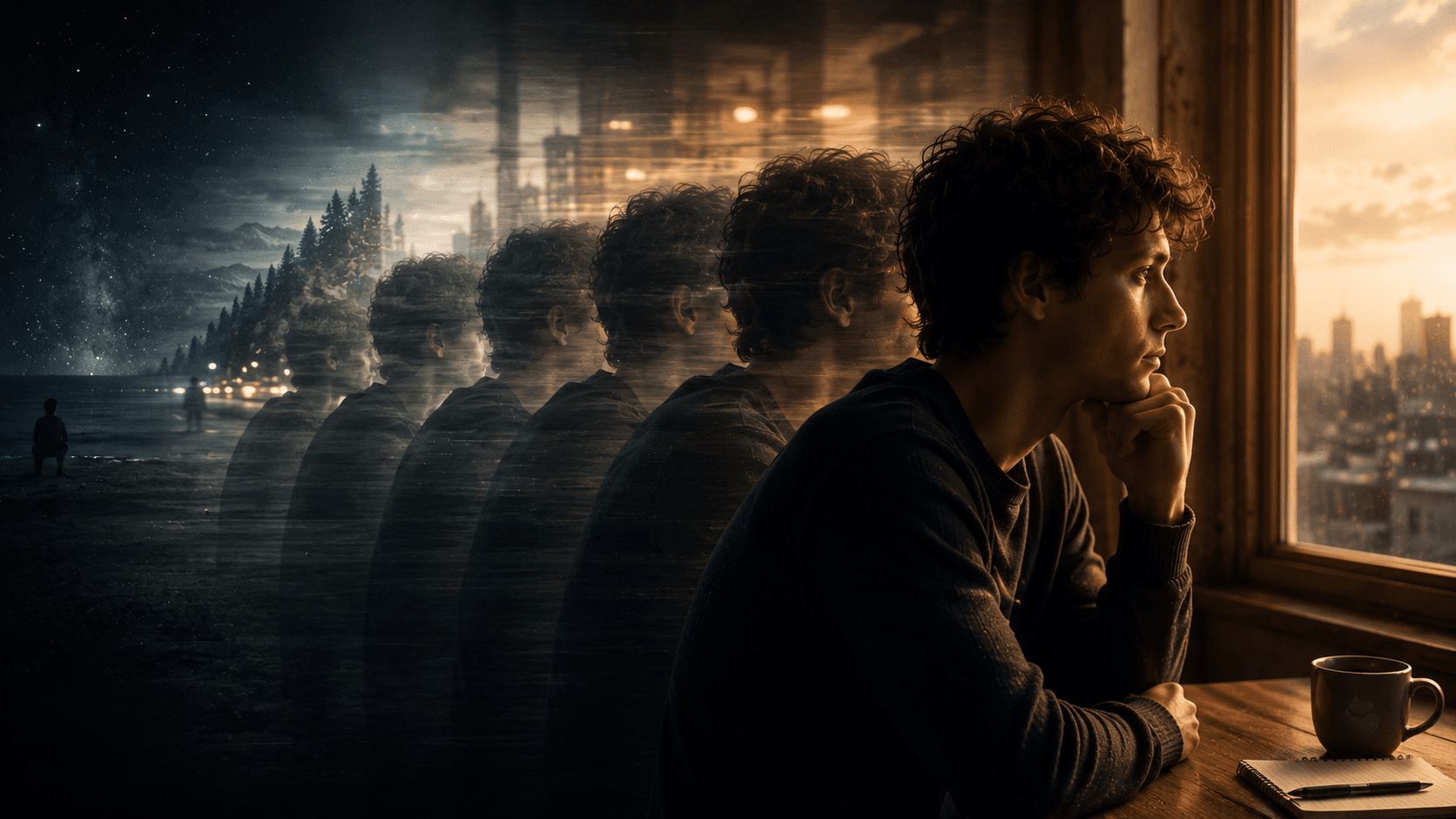
Right now, as you read this, you feel yourself to be in the present. The words arrive, the room is there, you are in it. It feels immediate. It feels live.
It is not. What you are experiencing is a reconstruction of events that already happened, assembled by a brain that takes time to do its work. By the time you are conscious of anything, the thing you are conscious of has already occurred. You are always, without exception, running slightly behind [1, 2].
The lag is small. Somewhere between 80 and 500 milliseconds depending on the type of signal and the complexity of the processing involved. Not enough to notice in ordinary life. Not small enough to be philosophically unimportant. You have never experienced a present moment. You have only ever experienced the very recent past, assembled into the feeling of now.
The present is not something you live in. It is something your brain manufactures from a past that just finished.
The lag is real and measurable
The signals from your senses do not arrive in consciousness the way light arrives at a camera. They travel along nerves, get processed through multiple cortical stages, get cross-referenced against predictions and memories, and are finally assembled into a unified experience [3]. Each step takes time. The whole pipeline has a delay.
Experiments measuring the point at which people become conscious of a stimulus and the point at which that stimulus actually occurs show a consistent gap of roughly 80 to 150 milliseconds for simple sensory events [1]. For more complex events, events that require binding multiple sensory streams together into a coherent experience, the lag is longer.
What this means is that your experience of this moment is the product of processing that began in what is, technically, the past. Your brain is presenting you with a finished render, not a live feed.
The brain backdates
Here is where it gets stranger.
The brain does not present the experience as delayed. It presents it as now. And research suggests it does this partly through a process of backdating: the finished experience is tagged with a timestamp that places it at the moment the event occurred, not the moment the processing completed [4].
You feel the tap on your shoulder at the moment of contact. Not 100 milliseconds later when the signal actually reached consciousness. The brain reaches back and assigns the experience to the moment it infers it came from. Your sense of living in the present is partly the brain papering over its own latency.
This is useful. A system that flagged its own processing delay would produce a fundamentally disorienting experience of the world. So instead the lag is hidden, and the finished product is stamped as present tense. The seam is invisible unless you know to look for it.
You are also watching light from the past
The processing lag is only the smallest version of this problem.
The light arriving at your eyes from the objects in this room left those objects nanoseconds ago. Light from the sun left eight minutes ago. When you look at the night sky, the nearest star you can see without a telescope is over four light-years away: what you are seeing is where it was four years ago. The most distant objects visible to the naked eye, faint smudges in a very dark sky, show you light that left millions of years before humans existed [5].
Astronomy is the most dramatic version of something that is true at every scale. You are never perceiving what is. You are perceiving what was, at a distance from you that ranges from nanoseconds to billions of years depending on where you look. The present, as a universal category of things that are happening right now across the whole of reality, is not accessible. It may not even be coherent. Relativity tells us that simultaneity is frame-dependent: two events that are simultaneous to one observer are not simultaneous to another moving at a different velocity [6]. The present you inhabit is yours. It is not shared.
What the specious present actually is
William James, in 1890, introduced the concept of the specious present: the felt sense of now, which he estimated at roughly a few seconds [7]. His point was that consciousness does not experience time as a series of durationless instants but as a short window with some depth to it, a moving bubble of apparent nowness.
The neuroscience has since given this concept more structure. The brain integrates sensory information over a window of roughly 2 to 3 seconds and presents it as a unified present moment [3]. Events that fall within the window get pulled together into the experience of now. Events outside the window get sorted into before and after.
What you call the present is the output of a temporal integration process. It is not a point. It is a small bubble of recent past that the brain assembles and presents as live.
The point
You are not running late. You are not failing to be present. You are a biological system with processing time, living inside the output of that processing, experiencing it as now because that is what the output is designed to feel like.
The present you inhabit is always constructed from what just finished happening. The feeling of immediacy is real. The immediacy itself is not. And the further out you look, the further back in time you are seeing, until the sky at night becomes not the present moment of the universe but a kind of sprawling archive, billions of years deep, that happens to be arriving at your eyes right now.
The Reality Scientist move here is not to find this destabilizing. It is to find it clarifying. You are not inside time looking out. You are a system that processes time, generates an experience of now, and lives inside that generated experience. The now is yours. It is made. And it is the most intimate and immediate made thing you will ever have access to.
Sources
- Libet, B., Gleason, C. A., Wright, E. W., & Pearl, D. K. (1983). "Time of conscious intention to act in relation to onset of cerebral activity." Brain 106(3): 623-642. The foundational study on the gap between neural events and conscious experience.
- Eagleman, D. (2011). Incognito: The Secret Lives of the Brain. Pantheon. On the brain's temporal processing and the construction of the present.
- Pöppel, E. (1997). "A hierarchical model of temporal perception." Trends in Cognitive Sciences 1(2): 56-61. On the 2-3 second integration window underlying the specious present.
- Eagleman, D. & Sejnowski, T. J. (2000). "Motion integration and postdiction in visual awareness." Science 287(5460): 2036-2038. On temporal backdating and the brain's construction of a coherent timeline.
- Carroll, S. (2010). From Eternity to Here: The Quest for the Ultimate Theory of Time. Dutton. On cosmological time, light travel, and the structure of temporal experience.
- Einstein, A. (1905). "Zur Elektrodynamik bewegter Körper." Annalen der Physik 17: 891-921. On special relativity and the frame-dependence of simultaneity.
- James, W. (1890). The Principles of Psychology. Holt. On the specious present and the structure of temporal consciousness.