
Time Is Change Made Memorable
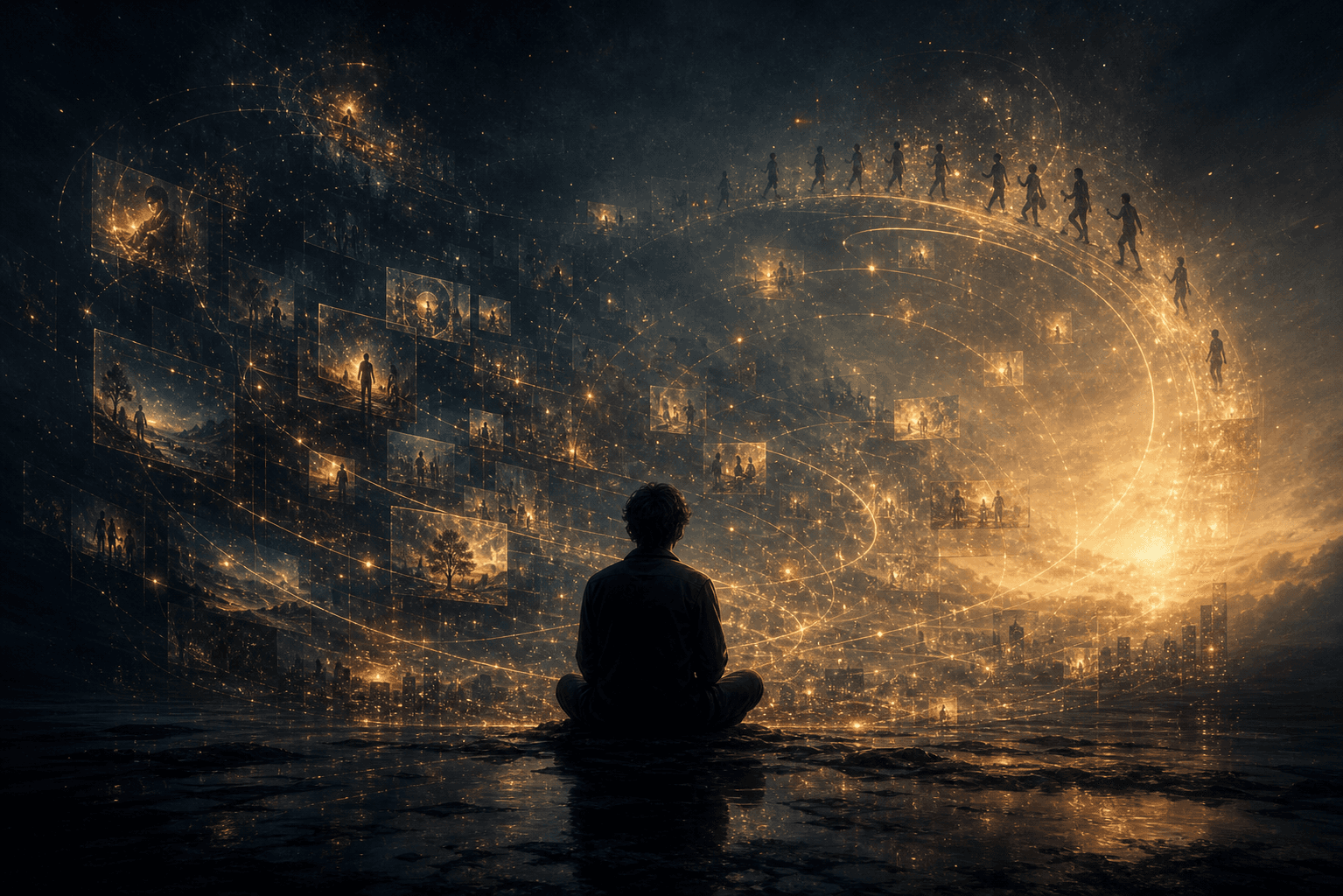
Sit with your eyes closed and nothing much happening, and something strange occurs: you lose track of how much time has passed. Was that two minutes or ten? You cannot say. The clock kept running, but your sense of duration went blank. Open your eyes in a busy room and time becomes legible again, measured against everything moving and changing around you.
This reveals that experienced time is not a quantity the mind reads directly. It is reconstructed after the fact from how much distinguishable change got recorded. When change stops being encoded, the evidence of duration disappears, and the mind is left unable to say how much time went by.
Experienced time is not felt as a raw quantity. It is inferred from encoded change. When many distinguishable signals are recorded, time feels thick. When almost nothing is recorded, time becomes thin and impossible to measure.
Time is inferred, not sensed
There is no sense organ for time the way there is for light or sound. The mind does not receive duration as a direct signal. Instead, it reconstructs how much time passed by reading the record of what changed, and inferring a duration from the amount of change [1].
When your eyes are open and things are happening, time is continuously encoded through signals: sounds, movements, visual shifts, thoughts, bodily sensations, interruptions, emotional beats, small events. Each of these leaves a mark, a before and an after, a distinguishable change. Later the mind reads this record and reasons, in effect: a lot changed, so a lot of time must have passed; almost nothing changed, so probably little time passed [1, 2].
So experienced duration is a construction, built from the density of encoded change. The clock measures time externally and evenly. The mind measures it internally and unevenly, by counting the differences it managed to record. The two can diverge dramatically, because they are measuring different things: elapsed physical time versus the amount of remembered change [2].
Why stillness blurs time
This explains why sitting with closed eyes and no activity makes duration hard to judge. In that state, the mind is deprived of the signals it normally uses to calibrate time. There are fewer external events, fewer contrasts, fewer before-and-after markers. The scaffolding by which duration is normally estimated is gone [1].
Time still passes physically. The body still has its rhythms. But the conscious self needs encoded differences to have evidence of that passage, and in deep stillness, almost no differences get encoded. Moment A and moment B become nearly identical, with nothing to distinguish them, so the record that would let the mind reconstruct duration is never written. Without the record, the mind has to guess, and the guess is uncertain [1, 2].
This is the difference between time passing and time being registered. Time can pass while consciousness encodes almost none of it, and then the person has very little internal evidence of the passage. The blankness of stillness is not the absence of time; it is the absence of the encoded change that would have made the time legible [2].
Density explains the distortions
The same principle explains why time feels different at different intensities. Five minutes of pain can feel long, while five minutes of pleasant drifting can vanish. This is not a contradiction. Pain generates constant, high-intensity signals, filling the interval with encoded change, so the mind reconstructs a long duration. Drifting generates almost nothing memorable, so the same interval leaves little record and collapses into brevity [2].
This means the felt length of a stretch of time is governed by its memory-density, not by the clock. A signal-dense interval feels thick and long because it is packed with encoded differences. A signal-sparse interval feels thin and short, or disappears, because there is little to reconstruct a duration from. The clock is indifferent to this; experienced time is entirely shaped by it [1, 2].
This is why an eventful hour can feel substantial while an idle afternoon evaporates, and why, in retrospect, the relationship can even invert: a densely encoded period leaves a large memory that feels long in recollection, while empty time leaves nothing and shrinks. Duration, felt and remembered, tracks encoded change, not elapsed clock time.
Why altered states warp time
This model also explains why certain altered states distort time so dramatically. Anything that changes the density, intensity, or ordering of encoded experience will change experienced duration, because duration is built from exactly those things [3].
When a state floods the mind with signals, making each moment far more sensation-dense and meaning-dense than usual, a small amount of clock time becomes packed with encoded content, and time dilates: a minute feels enormous, even endless, because it contains what would normally be an hour's worth of recorded change. The interval is short by the clock and vast by memory-density [3].
When instead a state disrupts the sequencing, so that experience is no longer laid down as an ordered before-and-after chain, time can seem to disappear entirely. There may be plenty of signals, but they are not arranged into the linear order the mind uses to reconstruct duration. Instead of A then B then C, it becomes everything at once, or a loop, or a timeless now. So high signal density stretches time, while broken sequencing dissolves it, and both follow directly from the fact that experienced time is assembled from encoded, ordered change [3].
The point
Experienced time is not sensed as a quantity. There is no organ for duration. The mind reconstructs how much time passed by reading the record of encoded change and inferring a length from its density. Much change recorded, long duration reconstructed; little change recorded, short or blank duration.
This is why stillness blurs time. With eyes closed and nothing happening, almost no distinguishable change gets encoded, so the mind loses the markers it uses to calibrate duration and can no longer say how much passed. Time still passed; it simply was not registered. And it explains the everyday distortions: pain fills an interval with signals and feels long, drifting empties it and vanishes, because felt length tracks memory-density, not the clock.
The same mechanism explains why altered states warp time so strongly. Flood the moment with encoded signals and time dilates; disrupt the ordered sequencing and time dissolves into timelessness. In every case the rule holds: the clock measures time externally, but conscious time is change made memorable. Where nothing distinguishable is encoded, there is, for the experiencing self, almost no time at all.
Sources
- Zakay, D. & Block, R. A. (1997). "Temporal cognition." Current Directions in Psychological Science, 6(1): 12-16. On how the perception of duration is reconstructed from the processing and encoding of information and change, rather than sensed directly, and how attention and event density shape experienced time.
- Wittmann, M. (2016). Felt Time: The Psychology of How We Perceive Time. MIT Press. On how experienced duration depends on the density of remembered events and bodily and emotional signals, explaining why intense or eventful intervals feel long and empty ones vanish.
- Wittmann, M. et al. (2007). "Effects of psilocybin on time perception and temporal control of behaviour." Journal of Psychopharmacology, 21(1): 50-64. On how serotonergic psychedelics disrupt timing, working memory, and temporal control, altering experienced duration by changing how change is encoded and sequenced.