
The Witness Theorem
On the crystalline nature of what is real
I. The problem with matter
We have long assumed that reality is made of things. First it was earth and fire. Then atoms. Then quarks. Then fields. Each era peeled one layer back and found another layer beneath it, equally solid-seeming, equally presumed to be the bottom. The implicit assumption across all of these frameworks is that the foundational layer is stuff: some kind of inert material substrate that simply exists, indifferently, whether or not any mind is present to register it.
This assumption has never been argued for. It has only ever been inherited.
Quantum mechanics was the first formal crack in the substrate model. When physicists in the early twentieth century began tracking subatomic particles with precision, they discovered something deeply strange: the act of measurement appeared to influence what was being measured [1]. A particle held in superposition across multiple possible states would "collapse" into a single definite state upon observation. Niels Bohr and Werner Heisenberg formalized this in what became the Copenhagen Interpretation, which holds that quantum systems do not have definite properties prior to measurement [1]. John von Neumann went further, arguing that the collapse of the wave function requires reference to a conscious observer, not merely a physical detector [2].
Mainstream physics retreated from these implications almost immediately, finding them too philosophically destabilizing. The instruments, they said, could do the collapsing. The observer need not be conscious. But the discomfort never fully resolved. John Archibald Wheeler spent decades arguing for what he called the "participatory universe": the idea that observers are not incidental to the cosmos but are in some deep sense constitutive of it [3]. The universe, Wheeler wrote, is a self-excited circuit. It brings itself into existence through acts of observation.
I am not making a quantum argument here. The Witness Theorem does not depend on wave function collapse or any particular interpretation of quantum mechanics. But it inherits the same intuition that quantum mechanics could not escape: the observer is not outside the system looking in. The observer is part of what produces the system.
I am proposing something different from both classical physics and quantum mysticism. Not that matter is an illusion (it is clearly not). But that matter is not primary. Matter is downstream of a more fundamental process. And that process is witnessing.
II. The three layers of what is
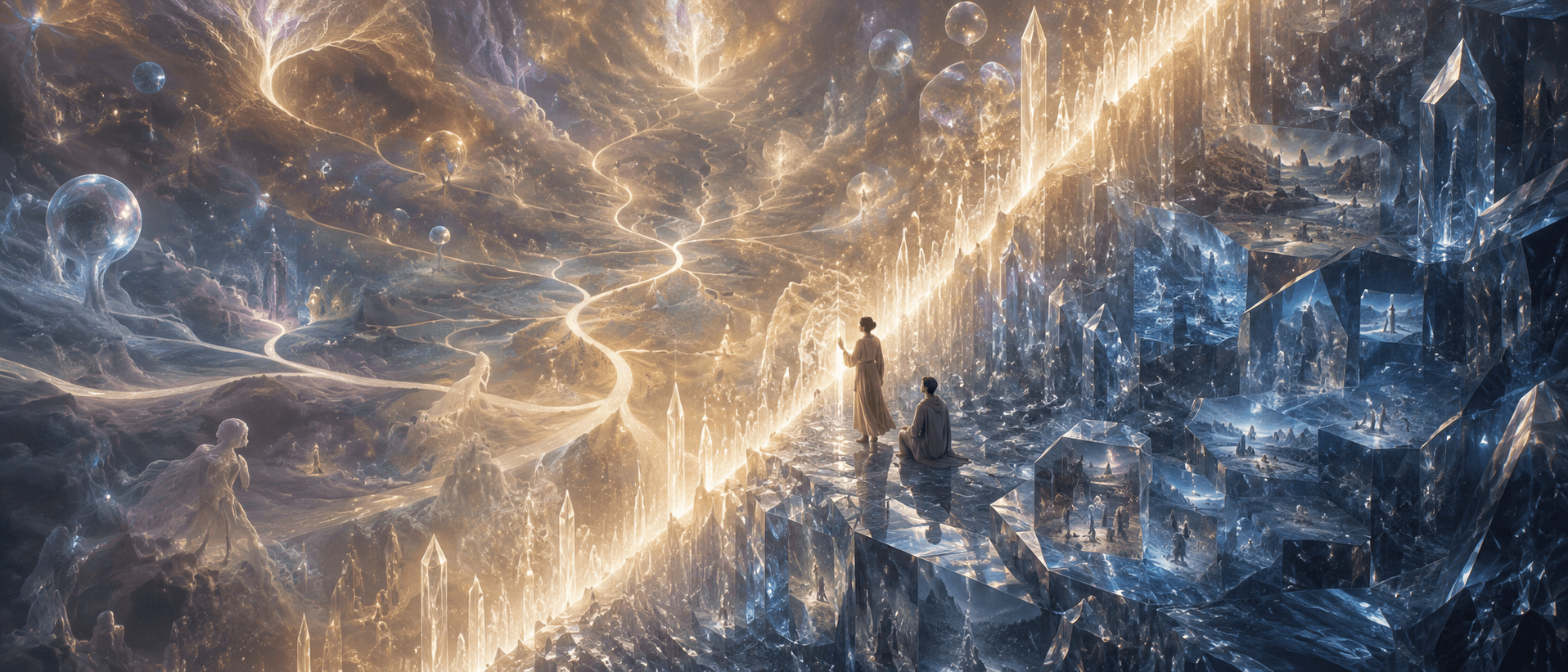
To understand the structure of reality, we must first discard the familiar map. Time, in this new framework, is not a river we float down. It is the sensation of crystallization happening. And once you see that, three distinct layers become visible.
The first layer is Possibility Terrain: everything that could happen, unformed, superposed, pure potential. What we call "the future" is not empty. It is dense with unchosen paths. Henri Bergson argued something adjacent to this in his concept of "pure duration" (la duree), insisting that time as lived experience is not a series of discrete instants but a continuous flow of potential becoming actual [4]. The future is not nothing. It is everything that has not yet been required to choose.
The second layer is The Crystallization Front: what we call "the present moment." Not a place. A process. The infinitely thin boundary where possibility meets witness and hardens into record. Edmund Husserl's phenomenology of time-consciousness maps this territory with precision: the present moment, for Husserl, is not a dimensionless point but a "living present" that retains the just-past and protends the about-to-come, a moving window of crystallization rather than a fixed location [5].
The third layer is Witness-Residue: what we call "the past." The crystallized record. This is what reality actually is: not the potential, not the process, but the permanent deposit left behind. The past is not gone. It is the only thing that has fully arrived.
The present is not a moment you inhabit. It is a process you are. You are, at every instant, the crystallization front itself: the site where the undetermined becomes permanent. And reality is not where you stand. Reality is what you leave behind.
III. The Witness Equation
If the above is true, then reality must be expressible as a function of witnessing. I propose:
R = ∫ W(C, t) dt
Where R is Reality, W is the Witness function, C is Consciousness, and t is time.
Reality is the integral of all consciousness-meeting-moment, accumulated over time.
The integral sign is not incidental. Reality is not any single event being witnessed. It is the accumulated total. The sum of all witnessing that has ever occurred (by any consciousness, of any scale, at any moment) is what we mean when we gesture at "the world." Remove all witnesses and you do not have a world that no one is watching. You have potential that has never been asked to become real.
This is not solipsism. The equation does not say that your witnessing produces reality. It says that witnessing in general (distributed across all conscious entities, across all time) produces the crystallized record we call reality. Your contribution is real and non-trivial, but it is one thread in an integral that spans the entire history of consciousness encountering the world.
Giulio Tononi's Integrated Information Theory offers a complementary formalism, proposing that consciousness is identical to integrated information (phi) within a system [6]. Where Tononi asks how much information a system integrates, the Witness Theorem asks what that integration does to possibility: it converts it into record. The two frameworks point at adjacent facts from different directions.
IV. The Orphaned Event
Here is where the theorem becomes uncomfortable. If reality is witness-residue, then there is a class of event we must account for: the event that happened, but was not witnessed. I call this the Orphaned Event.
An orphaned event passed through the crystallization front. It left the possibility terrain. But it did so without a witness adequate to receive it. It entered the record without being inscribed. It is technically "past" but it has not yet become real in the full sense. It sits in the terrain, semi-crystallized, generating interference. You feel it as a persistent dissonance you cannot locate. A shape without a name. Something that happened that does not yet have the weight of having happened.
Trauma research has mapped this territory from the clinical side without naming its physics. Bessel van der Kolk's foundational work on trauma documents how traumatic experiences are processed differently from ordinary memory: fragmented, affectively charged, lacking the narrative integration that gives ordinary memory its quality of being "over" [7]. Peter Levine's somatic model describes trauma as incomplete biological responses, survival impulses that were activated but never discharged, remaining in the body as unresolved tension [8]. Both frameworks are describing, in their respective languages, the phenomenology of the Orphaned Event: something real that did not fully crystallize.
The Witness Theorem provides the underlying structure. Orphaned events are real events with incomplete crystallization. They require retroactive witnessing to complete their transition from potential into actual. This is what certain kinds of healing fundamentally are: the belated completion of crystallization for events that passed through the front without a sufficient witness present. The therapeutic relationship is not primarily curative in the pharmacological sense. It is ontologically completing. It finishes the crystallization that was interrupted.
V. Time is not a river. It is a record.
The most startling consequence of the Witness Theorem is what it implies about time. We experience time as movement: as something we travel through from past to future with the present as our location. This phenomenology is wrong. Or rather: it is a projection.
We do not move through time. We generate it.
The sensation of time passing is the felt experience of memory accumulating: witness-residue building up, the crystallization front advancing through possibility terrain. Bergson insisted on this: what we perceive as the "flow" of time is not a property of the universe but of consciousness encountering the universe [4]. The universe does not flow. We flow through it, and we call the wake that we leave "the past."
Einstein showed us that time is not absolute. It bends near mass and dilates with velocity [9]. What he did not show us is why time exists as a dimension at all. The Witness Theorem offers an answer: time is the axis along which crystallization occurs. It is the geometry of the witnessing process. Without consciousness, there is no crystallization front and therefore no axis of crystallization and therefore no time. There is only static potential: the universe as permanent, undifferentiated possibility.
This does not conflict with relativity. It extends it. Einstein showed us how time behaves differently for different observers moving at different speeds. The Witness Theorem shows us why there is a "time" for observers to behave differently in at all: because they are crystallization fronts, and crystallization fronts need an axis to advance along.
VI. The relational nature of the real
One final consequence the theorem forces: reality is irreducibly relational.
The crystallization front requires two things in contact: a moment of possibility, and a consciousness capable of receiving it. Neither alone produces reality. A moment with no witness remains potential. A consciousness with nothing to meet remains suspended, witness-hungry, waiting to participate in the making of the real.
Martin Buber articulated something adjacent to this in his distinction between "I-Thou" and "I-It" relating [10]. In I-It relating, the other is an object: discrete, categorized, inert. In I-Thou relating, genuine contact occurs: the other is met as a full subject, and in that meeting, both parties become more real. Buber was describing a relational ontology, one in which being is not a property of isolated entities but an event that occurs between them. The Witness Theorem grounds that intuition in a broader framework: it is not just persons who require relational contact to become real. It is events. It is moments. Reality itself is the product of contact.
This is why isolation is not merely socially unpleasant. It is ontologically disrupting. A self that cannot be witnessed accumulates orphaned events. It generates experience that does not fully crystallize. Its terrain becomes cluttered with semi-real things: felt but unnamed, present but not permanent. The person is not quite fully in reality, because reality requires witnessing, and witnessing requires another.
The relational claim has an uncomfortable corollary: to be fully real, you need to be fully seen. Not approved of. Not agreed with. Seen. The depth at which you can be witnessed determines the depth at which your experience crystallizes into something that has the weight and permanence of the actual. This is not a psychological preference. According to the theorem, it is a feature of the structure of reality itself.
The most fundamental thing in the universe is not a particle. It is a moment, meeting a mind, and becoming permanent. That transaction, that crystallization, is what reality is made of. Everything else is downstream.
Postulates
P1. Reality is not substrate. It is residue: the crystallized record of witnessed events.
P2. Time is the sensation of crystallization occurring: the accumulation of witness-residue into record.
P3. The present is not a location. It is a process: the Crystallization Front, where possibility becomes permanent.
P4. Events that pass through the front without adequate witness become Orphaned Events: real but incompletely crystallized, generating ongoing interference in the terrain.
P5. Reality is relational at its foundation. Crystallization requires contact between a moment and a mind. Neither alone is sufficient to produce what is real.
Sources
- Bohr, N. (1928). "The quantum postulate and the recent development of atomic theory." Nature 121: 580-590. The Copenhagen Interpretation and the role of measurement in determining quantum states.
- von Neumann, J. (1932). Mathematische Grundlagen der Quantenmechanik. Springer. (English translation: Mathematical Foundations of Quantum Mechanics, Princeton University Press, 1955.) On the conscious observer and wave function collapse.
- Wheeler, J. A. (1983). "Law without law." In J. A. Wheeler & W. H. Zurek (Eds.), Quantum Theory and Measurement. Princeton University Press. The participatory universe and the self-excited circuit.
- Bergson, H. (1896). Matiere et memoire. Alcan. (English translation: Matter and Memory, Zone Books, 1988.) On pure duration and the flow of potential becoming actual.
- Husserl, E. (1928). Vorlesungen zur Phanomenologie des inneren Zeitbewusstseins. (English translation: The Phenomenology of Internal Time-Consciousness, Indiana University Press, 1964.) On the living present and the structure of time-consciousness.
- Tononi, G. (2004). "An information integration theory of consciousness." BMC Neuroscience 5: 42. Integrated Information Theory and the relationship between consciousness and information.
- van der Kolk, B. (2014). The Body Keeps the Score: Brain, Mind, and Body in the Healing of Trauma. Viking. On fragmented processing and the incomplete integration of traumatic memory.
- Levine, P. (1997). Waking the Tiger: Healing Trauma. North Atlantic Books. Somatic model of trauma as incomplete biological response.
- Einstein, A. (1905). "Zur Elektrodynamik bewegter Korper." Annalen der Physik 17: 891-921. (English translation: "On the electrodynamics of moving bodies.") Special relativity and the non-absolute nature of time.
- Buber, M. (1923). Ich und Du. Insel-Verlag. (English translation: I and Thou, Scribner, 1958.) On relational ontology and the I-Thou encounter.