
The Team Is Not the Players
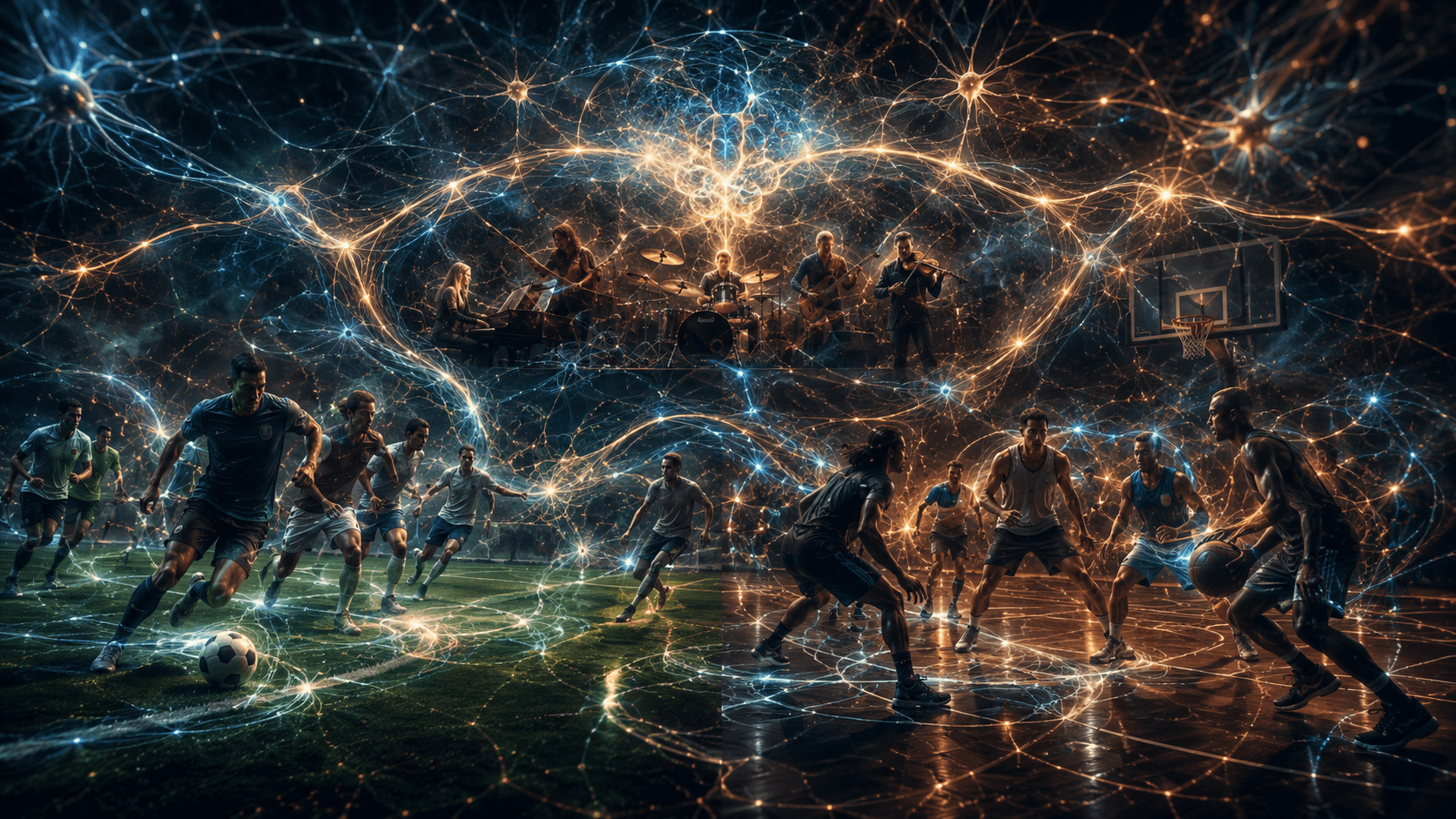
There is a moment in team sports that everyone who has played recognizes but almost no one knows how to describe. The point guard glances without looking. The cut happens before the call. Something between two players becomes so efficient that it stops resembling communication and starts resembling a single organism making a decision.
That moment is not magic. It is a structural event. And understanding what it actually is changes what it means to be part of any group.
When people synchronize around a shared task, a larger intelligence appears between them that no single person fully owns or controls. The team is not the players. The team is the pattern the players make possible.
The individual is a node, not the unit
What is happening when a team falls into sync is not that the players are cooperating well. Cooperation implies discrete individuals exchanging instructions and making separate decisions. What happens in peak group performance is different in kind. Each person becomes a sensing-and-acting node inside a larger pattern that does not exist inside any single skull [1, 2].
The soccer player in a live game is not processing the ball, the field, and their teammates as three separate problems. They are processing a unified field. They know where the pass is likely to go not because they have been told but because they are inside a shared perceptual structure. The defender's shoulder angle is meaningful. The pause in the midfielder's weight transfer is meaningful. The rhythm of the whole is readable. That reading is not a private calculation. It is a form of shared attention organized around the task.
The basketball team functions the same way. The band functions the same way. A surgical team, a flight crew, a group of improvising musicians locked in a phrase: in each case, the individuals stop being the unit of analysis. The real unit is the coordination field that forms between them [3].
Why chemistry is not a metaphor
People use the word chemistry to describe what it feels like when a team works. The word is usually treated as vague, romantic, impossible to analyze. It is none of those things. Chemistry is the felt signal of low translation cost between nervous systems [4].
When two players have chemistry, their nervous systems predict each other well. The timing is compatible. The read of the shared field is close enough that they do not have to repair constant mismatches. The coordination runs without friction because the nodes are well-matched.
When chemistry is absent, the opposite happens. Each player's action requires extra processing by the others, the rhythm breaks, and the coordination field becomes expensive to maintain.
This also explains why one disruptive person can destroy an otherwise capable team. A single node with poor timing, excessive ego, fear, or the inability to read the shared field does not merely underperform. They force the entire system to reorganize around the cost of including them. The other nodes spend more energy managing the disruption than expressing the task. The group becomes less intelligent. Not because individuals became less skilled. Because the coordination architecture degraded [5, 6].
The music lives between them
A band is the cleanest metaphor for this because the failure mode is audible. In a locked-in band, the music is not inside the guitarist, bassist, drummer, or singer separately. The music exists in the coordination between them. Each musician is both following and creating the shared rhythm. The drummer is not just keeping time. He is regulating the nervous system of the group. The guitarist leaving space for the singer is not a courtesy. It is the expression of a perceptual awareness that only exists because the group is functioning as a system.
When one member plays for themselves, the collapse is immediate. You can hear it. The music becomes a collection of parts rather than an emergent whole. Not because the playing got technically worse. Because the field between the players broke down.
The point
Groups are usually described from the inside out: assemble good individuals and a good group follows. This is sometimes true and often not. What actually determines group intelligence is whether the individuals can form a coordination field. Whether their nervous systems can synchronize around a shared task without constant friction and repair.
The better version of "hire talented people" is "find people whose perceptual timing and attention quality are compatible with the task." The team is not the players. The team is what forms between the players. And that emergence is the actual intelligence in the room.
Sources
- Hutchins, E. (1995). Cognition in the Wild. MIT Press. Foundational work on how cognition is distributed across individuals, tools, and environments.
- Clark, A. (2008). Supersizing the Mind. Oxford University Press. On how cognition extends beyond the individual brain into tools, language, and other people.
- Sebanz, N., Bekkering, H., & Knoblich, G. (2006). Joint action: bodies and minds moving together. Trends in Cognitive Sciences, 10(2), 70-76. On how people form shared representations during coordinated action.
- Wiltermuth, S. S. & Heath, C. (2009). Synchrony and cooperation. Psychological Science, 20(1), 1-5. Empirical work showing how synchrony between people increases coordination and mutual prediction.
- Csikszentmihalyi, M. (1990). Flow: The Psychology of Optimal Experience. Harper & Row. On group flow as a distinct state in which collective intelligence exceeds individual capacity.
- De Jaegher, H. & Di Paolo, E. (2007). Participatory sense-making. Phenomenology and the Cognitive Sciences, 6(4), 485-507. On how meaning and intelligence emerge through joint interaction rather than individual processing.