
The Stressor Without Refuge
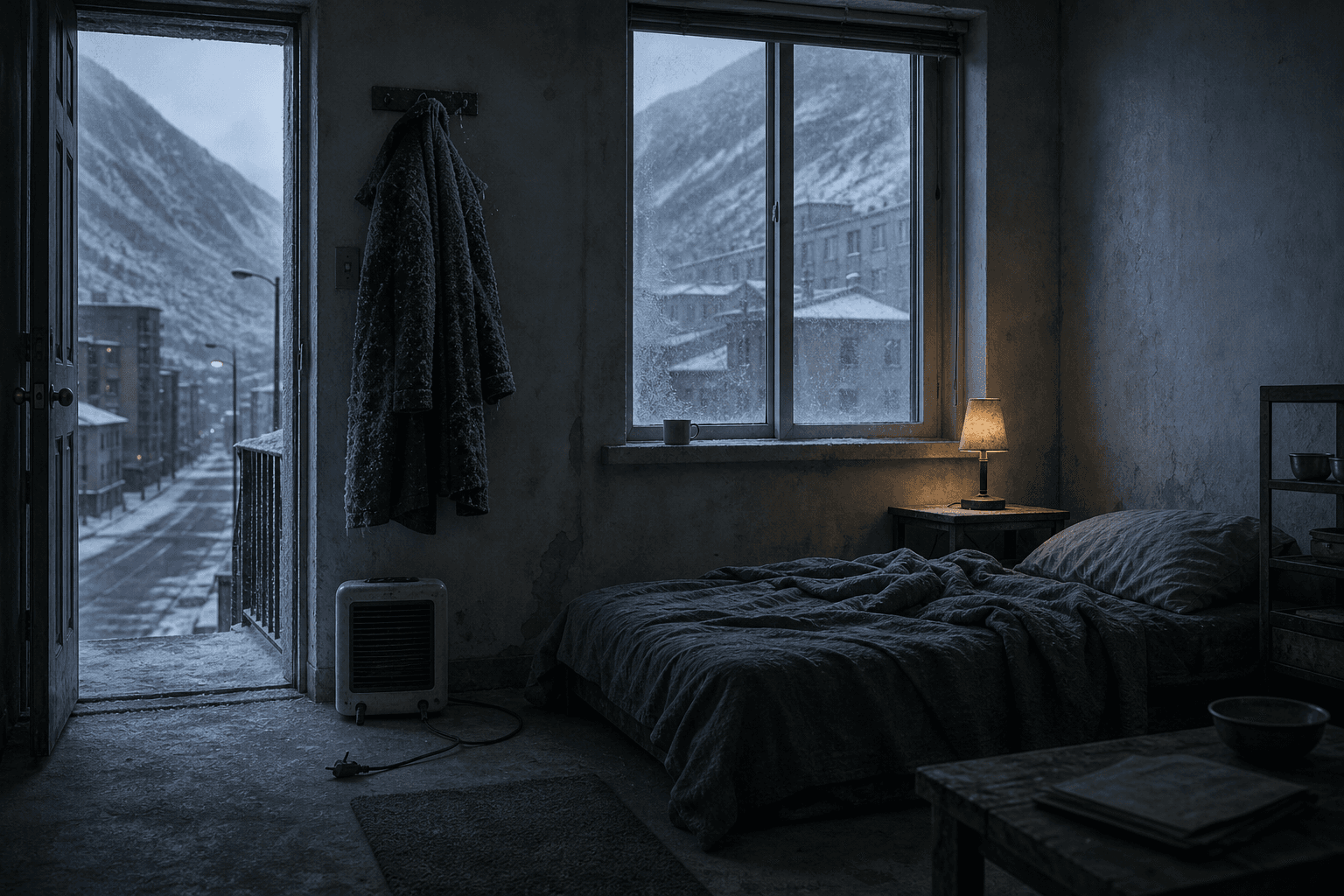
There is a specific kind of misery in a cold place where the indoors is also cold. Outside, you expect the cold; you brace for it, you endure it, and you carry the promise that when you get back to where you live it will be warm and you can finally relax. But if the room is cold, and the bed is cold, and the walls hold the cold, that promise is broken. The cold follows you inside like a second atmosphere, and there is nowhere to recover from it. That is what makes it feel unbearable, and it is not really about temperature.
The principle underneath is that what depletes a nervous system is not the intensity of a stressor but the absence of a refuge from it. A stressor you can escape and a stressor you cannot escape are categorically different harms, even at the same intensity, because the first permits recovery and the second does not. The body is built to endure hardship in pulses, bracing and then standing down. Remove the standing-down and a tolerable stressor becomes a corrosive one, not because it grew stronger but because the recovery disappeared.
What depletes a nervous system is not the intensity of a stressor but the absence of a place to recover from it. A stressor with refuge and the same stressor without refuge are different harms, because the body endures hardship in pulses and is worn down by what it can never stand down from.
The pulse the body is built for
The stress response is designed to be temporary. Faced with a threat, the body mobilizes, tenses, raises alertness, spends resources, and this mobilization is adaptive precisely because it is meant to end. After the threat passes, the system is supposed to return to baseline, recover the spent resources, and rest. The whole design assumes a pulse: activation, then recovery, then activation again if needed [1].
Recovery is not a luxury appended to the stress response; it is half of the mechanism. The activation is survivable because it is followed by a return to rest, during which the body repairs and restores what the activation consumed. A stressor endured and then recovered from leaves the system intact, because the recovery phase does the work of undoing the cost. The pulse is sustainable in a way that constant activation is not [1, 2].
This is why the promise of refuge matters so much. Bracing against the outdoor cold is tolerable because it is understood as a pulse: endure now, recover soon, in the warm room that waits. The bracing is bounded, and the boundary is the refuge. The body can spend freely against a hardship it knows it will get to recover from, because the recovery is built into the plan [1, 2].
When the refuge is removed
Remove the refuge and the pulse cannot complete. If there is no warm room to return to, the bracing never ends; the activation that was meant to be temporary becomes continuous, because the condition that would let it stand down never arrives. The body stays mobilized against a stressor it can never escape, and mobilization that never resolves is exactly the state the system is not built to sustain [2, 3].
The damage of this is not caused by the stressor being severe. Indoor cold in a mild climate is not physically extreme. The damage is caused by the absence of recovery, by the fact that the nervous system is denied the standing-down phase and held in low-grade activation around the clock. It is chronic, unresolvable activation, not intensity, that wears the system down, and the same stressor made escapable would not do it, because then the recovery phase would return [2, 3].
So the harm is located in the missing refuge, not in the stressor itself. Two people can face an identical hardship, and the one who can retreat from it periodically is fine while the one who cannot is slowly depleted, and the difference between them is not the hardship, which is the same, but the presence or absence of a place to recover. The stressor without refuge is a different category of thing from the stressor with refuge, even when the stressor is physically identical [3].
The deprivation of a place to stand down
This is why the experience of a refuge-less stressor feels less like discomfort and more like being unheld by the world. A refuge is not merely comfort; it is the signal that permits the nervous system to release its guard, the cue of safety that says the vigilance can stop now. Without any such place, the system receives no permission to stand down, and it remains braced, subtly, everywhere, all the time [3].
What is lost, then, is not the pleasant thing but the recovering thing. The warm room is not primarily a source of comfort; it is the place where the body is allowed to stop defending itself. To have no such place is to be deprived of the off-switch, to live in a state where there is no location and no moment in which the guard can fully come down. The cold that follows you indoors is unbearable not because it hurts more than the cold outside but because it takes away the only place the hurt was supposed to end [3].
This generalizes far past temperature. Any stressor becomes a different order of problem when there is no refuge from it: a relationship with no reliable moments of ease, a mind with no respite from its own vigilance, a life with no place where the guard comes down. In each case the intensity may be moderate, and the harm severe, because the harm is coming from the unrelenting quality, the absence of a stand-down, not from the peak of the stressor. The refuge is what converts a hardship into something survivable, and its absence is what converts the same hardship into something that grinds [1, 3].
Building refuge before reducing the stressor
The practical implication inverts the usual instinct. Faced with a refuge-less stressor, the instinct is to attack the stressor, to make it less intense. But if the harm is coming from the absence of recovery rather than the intensity, then the higher-leverage move is often to build a refuge, to create even a small, reliable place where the guard can come down, rather than to reduce a stressor that may not be that intense to begin with [2, 3].
In the literal case this is concrete: a single heated room, a hot water bottle, a warm bed, one reliable place to recover, changes the situation more than lowering the overall cold would, because it restores the pulse. The stressor can remain and the harm still drops, because what was missing was never a reduction in cold but a place to stand down from it. Restore the recovery phase and the same stressor becomes endurable again [2, 3].
The general lesson is to diagnose refuge-less suffering correctly. When something feels unbearable out of proportion to its intensity, the question is not only how strong the stressor is but whether there is anywhere to recover from it, because unrelenting mild stress can be worse than intense stress with recovery. The nervous system is built to endure almost anything in pulses and to be worn down by almost anything without them. The first thing to secure, often, is not relief from the stressor but a refuge from it, a place and a moment where the body is finally allowed to stop bracing.
The point
The stress response is built to be a pulse: activate against a threat, then return to baseline and recover. Recovery is not an add-on but half of the mechanism, because the activation is survivable only if it is followed by the standing-down that repairs its cost. This is why the promise of refuge matters so much. Bracing against a hardship is tolerable when it is bounded by a place to recover, since the body can spend freely against a stressor it knows it will get to stand down from.
Remove the refuge and the pulse cannot complete. With no place to recover, the temporary activation becomes continuous, and the system is held in low-grade mobilization it is not built to sustain. The damage comes not from the stressor's intensity, which may be mild, but from the absence of recovery, so that two people facing an identical hardship diverge entirely depending on whether either can periodically retreat from it. A stressor with refuge and the same stressor without refuge are different categories of harm.
What is lost with the refuge is not comfort but the off-switch, the cue of safety that lets the nervous system release its guard. This is why refuge-less stress feels like being unheld by the world, and it generalizes past cold to any relationship, mind, or life with no reliable place where the guard comes down. The practical inversion follows: when suffering is out of proportion to a stressor's intensity, build a refuge rather than only attacking the stressor, because the body can endure almost anything in pulses and is ground down by almost anything without them.
Sources
- Selye, H. (1956). The Stress of Life. McGraw-Hill. On the general adaptation syndrome, the phased nature of the stress response, and the exhaustion that results when activation is prolonged without a return to rest.
- McEwen, B. S. (1998). "Stress, adaptation, and disease: Allostasis and allostatic load." Annals of the New York Academy of Sciences, 840: 33-44. On allostatic load, the cumulative cost of stress responses that are not turned off, and how the failure to recover, rather than the stressor's magnitude, drives physiological damage.
- Porges, S. W. (2011). The Polyvagal Theory. Norton. On how cues of safety permit the nervous system to stand down from defensive mobilization, and how the absence of such cues sustains a chronic guarded state that the system cannot easily release.