
Dinosaurs Still Exist
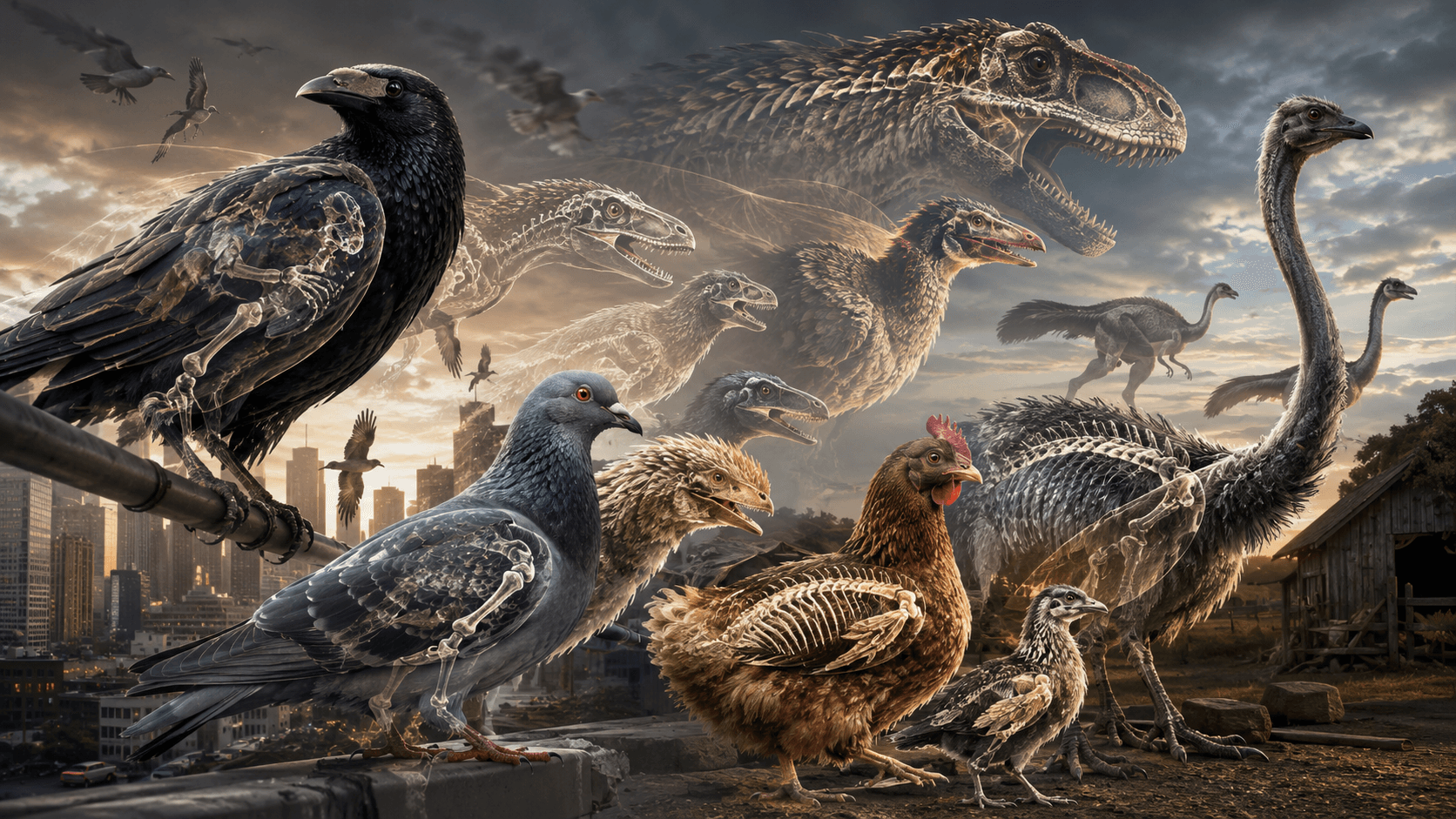
There is a sentence that is technically correct, factually undisputed in evolutionary biology, and almost never said out loud in everyday life. The sentence is this. Dinosaurs did not go extinct. One branch of them did not just survive but radiated into thousands of species, and we see them every single day, and we call them birds.
The pigeon outside your window is not a metaphorical dinosaur. It is a literal dinosaur. The lineage was never broken. The word was just changed.
This is not a poetic stretch. Birds are not "descended from" dinosaurs the way humans are descended from earlier primates. Birds are dinosaurs. They are members of the same evolutionary group, theropoda, that also includes Tyrannosaurus and Velociraptor [1]. In any honest taxonomy, you cannot draw a line that puts T. rex inside the dinosaurs and the chicken outside [2]. They are on the same branch. The branch did not stop. The asteroid trimmed it. What survived continued [5].
Why we do not feel this
If dinosaurs are still here, why does it not feel that way. Why does the word "dinosaur" still produce, in almost everyone, a picture of something extinct, ancient, and gone, instead of a picture of a sparrow.
Because the language did the editing for us. The word "dinosaur" was invented before the connection to birds was understood. By the time the connection was confirmed, the word was already culturally locked to mean "huge extinct reptile from a long time ago." Renaming was not really an option, so a quiet split happened. Scientifically, birds are dinosaurs. Colloquially, dinosaurs are dead. The two definitions coexist by ignoring each other.
This is one of the cleanest examples in modern science of how a word can prevent a true thing from being felt. Everyone "knows," in a thin technical sense, that birds came from dinosaurs. Almost no one walks past a flock of pigeons and feels what that fact would actually mean if it were taken seriously. The feeling is blocked by the word. The word says one thing, and the world is the other thing, and the word wins.
What it would mean to actually feel it
Imagine for a moment that you took the science seriously, in your body, not just as a fact to recite. You walk outside. The crow on the wire is a small theropod that has been refining itself for sixty six million years since the asteroid. It has the same lineage as the giants in the museum. It has feathers because its ancestors had feathers, going back well before the impact, on animals that we would absolutely call dinosaurs if we found their fossils. It builds nests because its ancestors built nests. It vocalizes because its ancestors vocalized. The behaviors are not new. They are ancient. The crow is a dinosaur that has been continuously alive for as long as there have been dinosaurs.
Now look at a chicken. Look at the way it walks, the head movement, the cocking, the watching. That is not a chicken behavior. That is theropod behavior, preserved with very little modification. You are watching a small dinosaur go about its day. The fact that you can buy it at a store does not change what it is. It changes what you have done to it.
Now look at an ostrich. Look at the legs. Look at how it runs. That is the closest thing currently alive to what a Velociraptor actually moved like. Velociraptor was not the lizard from the movie. It was a feathered, fast, sharp clawed bird thing about the size of a turkey [3, 4]. There is one in your local farm if you know where to look. The species is gone. The lineage is right there.
Why this matters
It matters because it changes what extinction means. Most people use "extinct" the way they use "deleted." Gone, finished, not coming back. But the actual history of life on this planet rarely works that way at the level of major lineages. Lineages do not end. They transform, branch, lose branches, keep going. The drama of "the dinosaurs went extinct" is half right. Most of them did. One branch did not [5]. That branch is now bigger, in number of species, than the mammals. There are about ten thousand species of birds. There are about six thousand species of mammals [2]. By that count, we live in a world more dominated by surviving dinosaurs than by us.
The reason this is hard to absorb is that the surviving dinosaurs are mostly small and feathered and quiet, and we filed them under a different word. The word is doing exactly what words do. It is keeping the world in tidy boxes that match how we already see it. Move the box and the world looks different. The sky was full of dinosaurs the whole time you were sad they were gone.
The point
Dinosaurs are not extinct. The category was renamed for one branch and retired for the others. The branch that kept the original lineage is currently sitting on a wire outside your window, watching you with a small, bright, extremely old eye. The asteroid did not end them. It just made the survivors smaller. They got better at flying. They are still here. We just stopped calling them what they are.
Sources
- Gauthier, J. (1986). "Saurischian monophyly and the origin of birds." Memoirs of the California Academy of Sciences 8: 1-55. The formal cladistic argument that birds nest inside Theropoda.
- Brusatte, S. (2018). The Rise and Fall of the Dinosaurs. William Morrow. Accessible synthesis of the bird-dinosaur lineage and post-impact radiation.
- Xu, X. et al. (multiple papers, Liaoning fossil beds, China). Discovery and description of feathered theropods bridging the morphological gap between non-avian dinosaurs and birds.
- Norell, M. & Xu, X. (2005). "Feathered dinosaurs." Annual Review of Earth and Planetary Sciences 33: 277-299.
- Field, D. J. et al. (2018). "Early evolution of modern birds structured by global forest collapse at the end-Cretaceous mass extinction." Current Biology 28(11): 1825-1831. On which lineages survived the K-Pg event.