
Between Containers
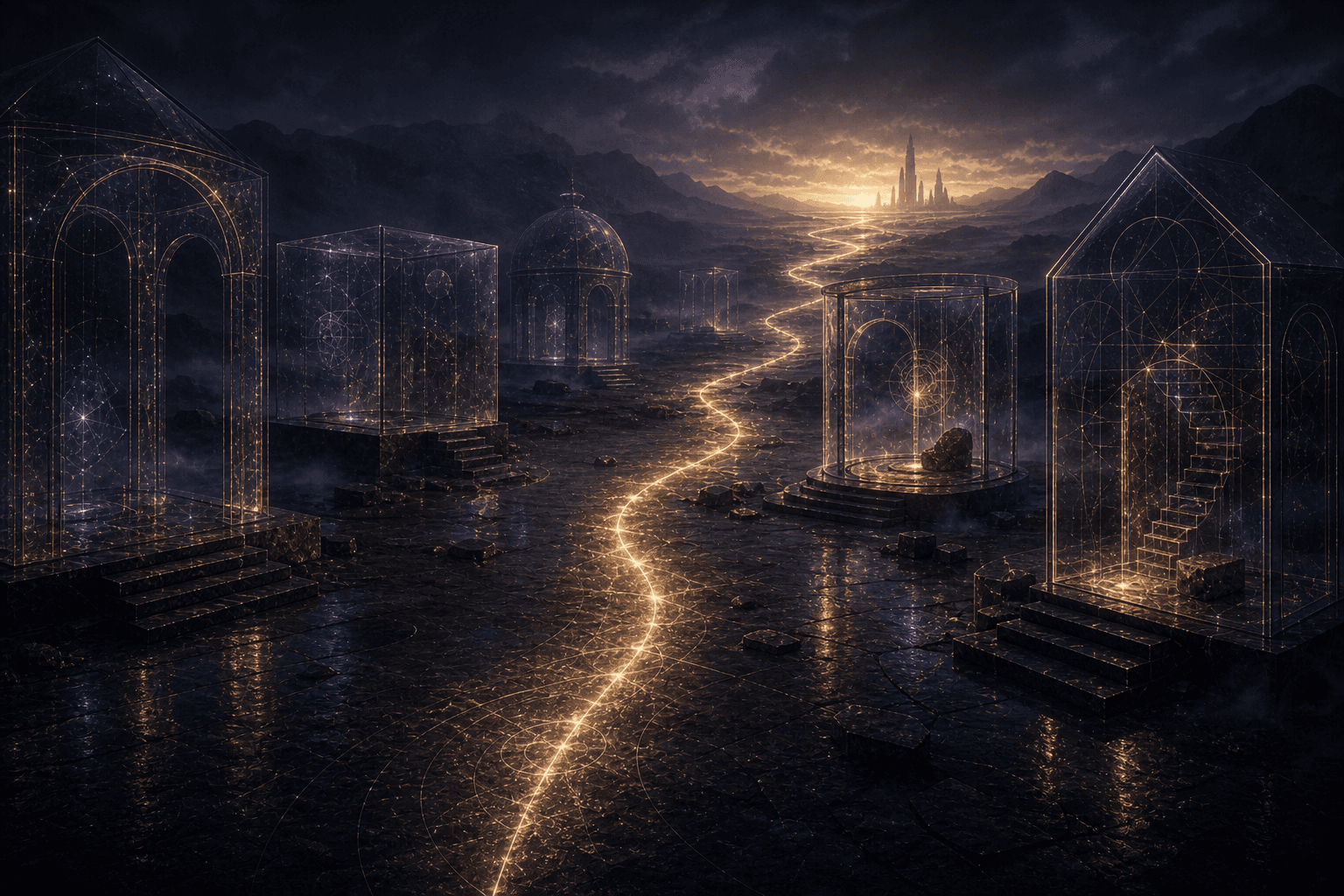
Someone who keeps moving, keeps trying places and communities and projects, none of which quite holds, is easy to read as lost. Drifting, wandering, without direction. But look more closely and the reading is often wrong. The person is not directionless. They know, with some clarity, the kind of life they want to build. What they lack is not direction but a container: a stable environment that can hold and support that direction. They are not lost. They are between containers.
This distinction matters because the two conditions look identical from outside, restless movement, repeated changes, dissatisfaction, and they are completely different inside. Lostness is the absence of direction. Being between containers is the presence of direction without a vessel, and the movement it produces is not aimless wandering but a search: testing environments, one after another, for whether they can hold the life the direction points toward.
Being lost and being between containers look identical from outside and are opposite inside. The lost lack direction. The between-containers have direction but no vessel to hold it, so their movement is a search for an environment that can support the life they already know they want.
Direction and container are different things
Building a life requires two separate things: a direction and a container. The direction is the sense of what life you are trying to build, where you are trying to go, what you want. The container is the environment that holds and supports that pursuit: the place, community, structure, or set of conditions within which the direction can actually be enacted. Direction is what you are aiming at; container is what you aim from [1].
These are genuinely separate, and either can be present without the other. A person can have a clear direction and no container: they know what they want and have no stable environment that supports building it. Or a person can have a container and no direction: they are settled in a supportive environment with no clear sense of what to do within it. The two are different possessions, and lacking one is a different condition from lacking the other [1, 2].
This is why "lost" is often a misdiagnosis. Lost means lacking direction. But a person can be full of direction and simply lack a container, and that produces a different condition that only resembles lostness on the surface. The restless movement of the container-less looks like the wandering of the directionless, but its source is opposite: not the absence of a destination, but the absence of a place from which to travel toward one [2].
Why the search looks like wandering
A person with direction but no container will move, and the movement has a specific character that is easily mistaken for aimlessness. They will try environments, one after another, entering places and communities and arrangements to see whether each can hold their direction. When one fails to, they leave and try another. From outside, this is a pattern of restless change, exactly what wandering looks like [2, 3].
But the movement is not wandering; it is testing. Each environment is being evaluated for a specific question: can this hold the life I am trying to build? The person is not moving randomly in the absence of a goal; they are moving systematically in search of a container for a goal they already have. The changes are not the drift of someone with nowhere to go but the search of someone who knows where they want to go and is looking for a base from which to go there [3].
This is why the movement, though it looks like wandering, has a logic wandering lacks. A wanderer would be equally content anywhere or nowhere, because there is no criterion. The person between containers has a sharp criterion, whether the environment supports the direction, and applies it to each place, which is why they keep leaving: most environments fail the test. The frustration is not aimlessness but the opposite, a clear aim meeting a series of environments that cannot hold it [2, 3].
Why so few environments pass
The defining frustration of being between containers is how few environments pass the test, and this follows from what the test requires. An environment that can hold a specific direction is not any environment; it must actually support that particular life, provide the conditions that direction needs. Most environments, being built for other purposes and other lives, do not, so most fail [1, 3].
This is why the search can be long and the changes many. It is not that the person is too restless or too hard to please; it is that the requirement is specific and most environments do not meet it. Each failed container is genuine information, this place cannot hold what I am building, and the accumulation of failures is not evidence of the person's aimlessness but of the rarity of environments that fit a particular direction. The more specific the direction, the fewer environments can contain it, and the longer the search [3].
So the repeated leaving is not a flaw in the person but a feature of the situation: a specific direction meeting a world mostly not built to hold it. The person keeps moving because they keep encountering environments that fail the test, and they keep applying the test because the direction is real and needs a container. The pattern that looks like an inability to settle is actually a refusal to settle into a container that cannot hold what one is trying to build, which is not restlessness but discernment [2, 3].
The remaining question
There is a deeper question that being between containers eventually forces, and it is the real frontier of the condition. If very few environments can fully hold a direction, then part of the resolution may not be finding the perfect container but distinguishing which parts of the container must come from the environment and which parts must be generated by the person regardless of where they are [1, 3].
This reframes the search. The assumption behind endless testing is that somewhere there is an environment that will fully hold the direction, and the task is to find it. But it may be that no environment fully passes, that every container supplies some of what the direction needs and none supplies all, and that the missing parts must be built by the person themselves, carried into whatever environment they are in. The search for the perfect vessel may be partly a search for something that does not exist [3].
So the maturation of being between containers is the shift from "find the environment that holds everything" to "determine what the environment must provide and what I must provide regardless." This does not abandon the search; some things genuinely must come from the environment, and those are worth searching for. But it stops waiting for a total container, and starts generating internally the parts no environment will supply. The person between containers is not lost, and their next step may not be a better container but a clearer division between what to seek outside and what to build within.
The point
Building a life requires both a direction and a container, and these are separate: the direction is what you aim at, the container is the environment you aim from. Either can exist without the other, which is why "lost" is often a misdiagnosis. A lost person lacks direction. A person between containers has direction and lacks a vessel, and this produces a condition that only resembles lostness on the surface.
The movement it produces looks like wandering but is actually a search: each environment is tested for whether it can hold the life the person is trying to build, and failed environments are left for new ones. This has a logic wandering lacks, a sharp criterion applied to each place, and the repeated leaving reflects not aimlessness but how few environments can hold a specific direction, since most are built for other lives.
The deeper question this forces is whether any environment can fully pass the test, or whether every container supplies only some of what a direction needs. The maturation of the condition is the shift from searching for a total container to distinguishing what must come from the environment and what must be generated by the person regardless of where they are. The person between containers is not lost. They have a direction and are looking for a vessel, and part of the answer may be building within what no vessel will provide.
Sources
- Lewin, K. (1951). Field Theory in Social Science. Harper. On how behavior and the pursuit of goals depend on the surrounding environment or field, and how the same direction requires a supportive environment to be enacted.
- Marcia, J. E. (1966). "Development and validation of ego identity status." Journal of Personality and Social Psychology, 3(5): 551-558. On the distinction between directionless exploration and committed, criterion-driven searching, and how apparent restlessness can reflect an active search rather than an absence of direction.
- Bronfenbrenner, U. (1979). The Ecology of Human Development. Harvard University Press. On how development depends on the fit between a person and their environments, and how few environments fully support a given trajectory, requiring both selection of settings and internal generation of what settings lack.