
The Authority of Pain

The moment before you pull your hand back from something hot is not a decision. It does not feel like a decision. Pain arrives and the hand withdraws, and the whole sequence collapses into a single reflex. Perception and response fused. You were not consulted.
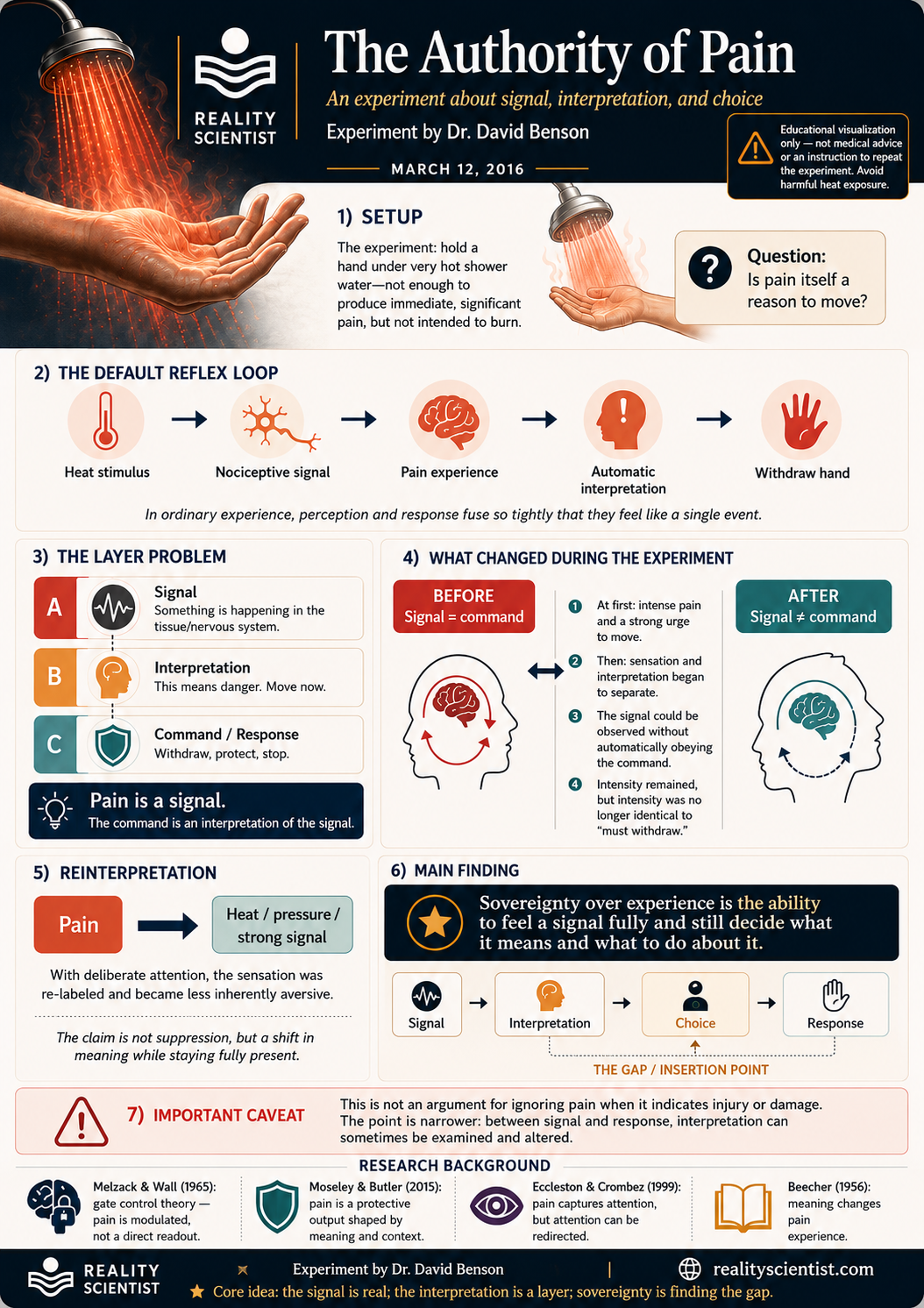
The experiment was simple. I put the shower as hot as it would go without being capable of burning me. I held my hand directly under the nozzle where the water exits first, where the temperature is at its maximum, and I left it there. The pain was immediate and significant.
The question I was holding was not whether it hurt. It did. The question was: is that a reason?
Pain is a signal. It is not, by itself, a reason. The experiment was about which layer of mind gets to decide what counts as a reason, and whether that layer could be you.
The layer problem
There are at least two things happening when pain arrives. The first is the signal: nociceptive input from the tissue, processed through the spinal cord and into the brain, where it becomes the experience of pain [1]. The second is the command: move, withdraw, protect. These are not the same thing. The signal is sensory. The command is interpretive. The signal says something is happening. The command says what to do about it.
In ordinary life, the gap between them is invisible. The signal arrives and the response follows so quickly that it feels like one thing. But they are two things. The signal is not the command. The command is an interpretation of the signal, issued by some layer of the system that has been trained, over a lifetime, to treat pain as an automatic override.
The experiment was about that layer. Specifically: who is it? Is it you? Or is it something running in you that you have never actually agreed to let run?
I wanted a reason to move. Not a feeling. A reason. Pain alone was not going to be that reason, because pain alone is just the signal. If I moved every time a signal arrived without examining whether it was a reason, then I was not operating from sovereignty. I was being operated.
What happened
For the first period, the pain was simply pain. Intense, clear, demanding. The demand was: move. I did not move.
After some time, something shifted. The pain did not disappear. But my relationship to it changed. What had been a single overwhelming experience began to separate into its components. There was the sensation. And then there was the interpretation that labeled the sensation pain and issued the command to withdraw. Those two things came apart.
Once they came apart, I could work with them separately. The sensation was still there, still strong. But I could examine it as a signal rather than receiving it as a command. And what I found was that the signal itself, stripped of its interpretation, was not inherently aversive. It was intense. Intensity is not the same as unbearable. The intensity that the system had been labeling as pain could, with deliberate attention, be re-labeled as something closer to heat, to pressure, to a very strong signal that did not inherently require the response the system had been mapping onto it [2, 3].
At the furthest point, I was able to reinterpret the signals as something that was almost pleasant. Not through suppression. Not by going somewhere else in my mind. By staying fully present with the sensation and changing the layer that decided what the sensation meant.
What sovereignty actually is
Sovereignty over experience is not suppression. It is not the ability to not feel things. It is the ability to feel things fully and still be the one deciding what they mean and what to do about them.
The ordinary state is that the interpretive layer runs automatically. Pain means move. Discomfort means stop. Anxiety means avoid. The signals arrive, the interpretations follow immediately, and the responses follow the interpretations. The whole sequence runs without your participation. You are present for it, but you are not running it. Something else is running it, using your body and your attention, and you have simply never questioned whether to let it [4].
The experiment was a question about that. Not whether the signals could be suppressed. Whether I could insert myself between the signal and the interpretation, between the interpretation and the command, and whether, once inserted, I could choose rather than simply follow.
The answer was yes. Not easily, not immediately, but the gap was there. The gap had always been there. It had just never been examined, so it had never been used.
The point
Pain is a signal with a default interpretation pre-loaded. The default says: this signal is a reason to stop, withdraw, avoid. The default runs automatically because it has been running automatically for so long that it presents itself as the only option.
It is not the only option. The signal is real. The interpretation is a layer on top of the signal, and that layer can be examined, adjusted, and in some cases replaced with something you chose rather than something you inherited.
This is not an argument for ignoring pain in contexts where it indicates damage. The body's warning systems exist for good reasons. The point is narrower: in the space between a signal and a response, there is a layer of interpretation, and that layer is, in principle, under your authority. Most people never find that layer because they never stop moving their hand long enough to look for it.
Sovereignty is not the absence of feeling. It is the presence of a self that remains the decision-maker even when the signals are strong.
Sources
- Melzack, R. & Wall, P. D. (1965). "Pain mechanisms: A new theory." Science, 150(3699): 971-979. The gate control theory: pain is not a direct readout of tissue damage but a signal modulated by the nervous system through multiple layers of processing, meaning the experience of pain is constructed rather than simply received.
- Moseley, G. L. & Butler, D. S. (2015). "Fifteen years of explaining pain: The past, present, and future." Journal of Pain, 16(9): 807-813. On pain neuroscience education: pain is an output of the brain produced as a protective response, not an input from tissue. The same tissue signal can produce radically different pain experiences depending on context, meaning, and attentional state.
- Eccleston, C. & Crombez, G. (1999). "Pain demands attention: A cognitive-affective model of the interruptive function of pain." Psychological Bulletin, 125(3): 356-366. On pain and attention: pain functions as an interruptive system that demands cognitive resources, but the degree of interruption is modulated by attentional control, meaning deliberate reallocation of attention can alter the pain experience substantially.
- Beecher, H. K. (1956). "Relationship of significance of wound to pain experienced." JAMA, 161(17): 1609-1613. The classic study of wounded soldiers who required little or no morphine despite severe injuries because the meaning of the wound (survival, escape from combat) altered the pain experience. Demonstrates that the interpretive layer is not incidental to pain but constitutive of it.